Hadrian is a saint of the Catholic Church (76 - 138).
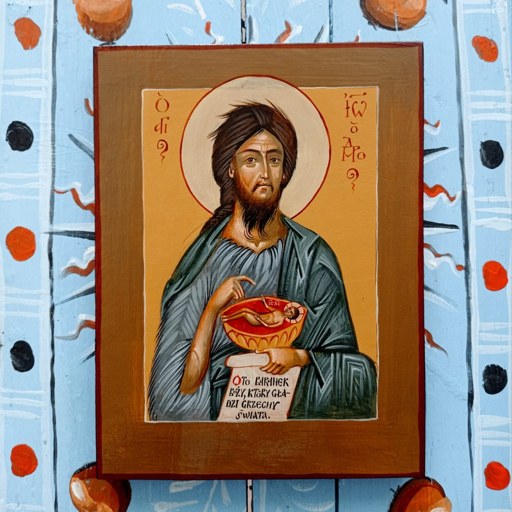
https://www.etsy.com/uk/listing/1518487637/saint-john-the-baptist-picture-icon
License: unknown
Hadrian
Saint- Life Span
- 76 - 138 (age 62)
- Gender
- male
- Church
- Catholic
Places
Roles & Family
Religious Information
Biography
Publius Aelius Hadrianus, the Roman emperor commonly called Hadrian, was born in the year 76 to a senatorial family of Italic origin long settled at Italica in Hispania Baetica. His father, Publius Aelius Hadrianus Afer, had reached the praetorship; his mother, Domitia Paulina, came from Gades. When Afer died, the future emperor Trajan, a kinsman from the same Spanish municipal aristocracy, and the equestrian Publius Acilius Attianus became the boy's guardians. Hadrian spent formative years in Rome, acquired a deep and lifelong attachment to Greek language and culture, and passed through the vigintivirate, military tribunates on the lower Danube and the eastern frontier, the quaestorship, and further posts under Nerva and Trajan. He took part in the Dacian wars, held the consulship, and was governing Syria when Trajan died in Cilicia in 117.
Hadrian's accession was announced as the result of a deathbed adoption by Trajan, though ancient writers already recorded doubts and attributed a decisive part to the empress Plotina and to Attianus. Once in power he abandoned Trajan's newly conquered territories in Mesopotamia and Assyria, executed four men of consular rank alleged to have conspired against him, and devoted the rest of a twenty-year reign to the inspection, fortification, and civic adornment of the existing empire. He was the most traveled of Roman emperors. In Britain the northern wall associated with his name was begun during his visit in the early 120s. He reorganized the Rhine and Danube frontiers and spent long periods in Greece, Asia Minor, and Egypt. At Rome he rebuilt Agrippa's Pantheon as the domed temple that survives, raised the Temple of Venus and Roma, and created the sprawling villa at Tibur. In Athens he completed the Temple of Olympian Zeus, founded the Panhellenion, and was commemorated by the arch that still stands near the Olympieion. His administration included the jurist Salvius Julianus's recasting of the praetor's edict, a landmark in the regularization of Roman law.
The later years of the reign were darkened by the revolt of Simon bar Kokhba in Judaea, which broke out in 132 after Hadrian had refounded Jerusalem as the Roman colony Aelia Capitolina and, according to some accounts, restricted circumcision. The war lasted until 135, cost both sides dearly, and ended with the destruction of the rebel state, the exclusion of Jews from the Jerusalem district, and the renaming of Judaea as Syria Palaestina. Hadrian had married Vibia Sabina, granddaughter of Trajan's sister Marciana; the marriage produced no biological children and, according to the biographical tradition, was unhappy. He formed an intense attachment to Antinous of Bithynia, who drowned in the Nile in 130. Hadrian founded Antinoopolis on the site, spread the cult of the deified Antinous, and commemorated him in sculpture throughout the empire. In 136 he adopted as heir Lucius Ceionius Commodus, who took the name Lucius Aelius Caesar but died on 1 January 138. Hadrian then adopted Titus Aurelius Antoninus, requiring him in turn to adopt Marcus Annius Verus (the future Marcus Aurelius) and Lucius, son of Aelius.
Hadrian's health collapsed in his final years. Ancient sources describe a painful, protracted illness and a deterioration in his relations with the Senate, including further executions of prominent men. He died at Baiae on the Bay of Naples on 10 July 138. Antoninus Pius succeeded him, overcame senatorial reluctance, and obtained Hadrian's deification. The emperor's remains were laid in the great circular mausoleum he had built on the bank of the Tiber, the monument later converted into the papal fortress of Castel Sant'Angelo. Hadrian left a reputation as a restless, cultivated, and often severe ruler whose frontiers, legal work, and buildings shaped the Roman world of the second century.