Helen of Anjou is a saint of the Catholic Church (d. 1314). Helen of Anjou's feast day is celebrated on 12 November.
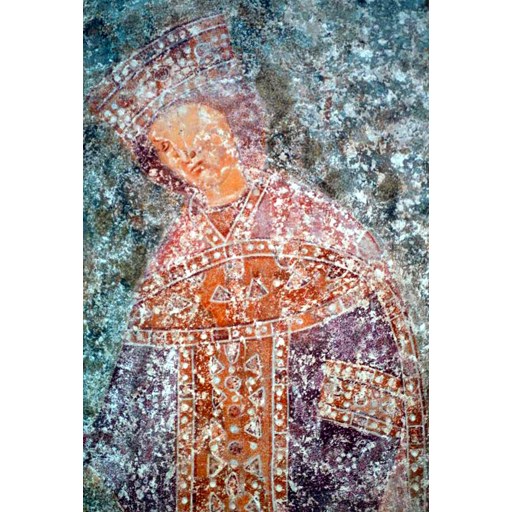
Unknow Serbian Orthodox afresco painter
License: CC0
Helen of Anjou
Saint- Life Span
- d. 1314
- Feast Day
- 12 November
- Gender
- female
- Church
- Catholic
Places
Relics & Where to Venerate
Location unknown
The bodily remains of Helen of Anjou are a first-class relic. Venerated at Gradac Monastery.
Roles & Family
Religious Information
Canonization
Biography
Helen of Anjou, known in Serbian as Jelena Anžujska, was queen consort of medieval Serbia as the wife of King Stefan Uroš I of the Nemanjić dynasty. Her exact year and place of birth are not securely recorded, and her parentage has long been debated. She is generally described as being of Western aristocratic origin, which explains the later epithet of Anjou. One influential scholarly reconstruction identifies her as a daughter of John Angelos, lord of Syrmia, and of Matilda of Vianden, which would situate her among the mixed Byzantine, Hungarian, and Latin nobility of the thirteenth-century central Balkans. Whatever the precise genealogy, she was raised in the Latin Catholic tradition, a background unusual for a Serbian queen in an otherwise Eastern Orthodox royal house, and she retained Western cultural and ecclesiastical ties throughout her life.
She married Stefan Uroš I, who ruled Serbia from 1243 until 1276, probably in the middle years of the 1240s. The marriage produced two sons who both became kings of Serbia: Stefan Dragutin and Stefan Uroš II Milutin. Sources also mention a daughter, often called Brnjača. As queen, Helen stood at the center of a court that presided over economic growth, including the development of mining, and over Serbia's widening contacts with Hungary, Dubrovnik, the Italian Adriatic, and Byzantium. In 1276 Dragutin deposed his father; Uroš I took monastic vows and died the next year. Helen then received a large appanage comprising Zeta, Trebinje, and adjoining coastal and hinterland districts, which she governed with substantial autonomy for many years from her own court, notably at Brnjaci in the Ibar valley.
Helen was among the most active royal patrons of her generation. Her principal Orthodox foundation was the Monastery of Gradac, erected in the later thirteenth century as her mausoleum church. Its architecture combines the Serbian Raška tradition with Western Gothic features, a visual counterpart to her own position between Latin and Orthodox worlds. She also endowed or protected other churches and was a documented supporter of Franciscan houses in the Catholic towns of the coast, while remaining a benefactor of Orthodox monasteries inland. Tradition rooted in the royal biographies credits her with founding a school for girls at her court and with extensive charity, including care for the poor and the ransoming of captives. Archbishop Danilo II, who had served at the Serbian court and later composed a Life of Queen Helen, presented her as a peacemaker, especially in reconciling her sons Dragutin and Milutin after Dragutin's abdication in 1282 and during later disputes over territory and succession.
In old age Helen took monastic vows, following the Nemanjić custom by which rulers and royal widows entered the religious life without necessarily abandoning all political influence. She died on 8 February 1314 and was buried at Gradac Monastery, where her tomb became a place of veneration. The Serbian Orthodox Church numbers her among its saints and commemorates Saint Queen Helen on 12 November. Because Danilo II wrote her biography within living memory of her death, and because Gradac and the documentary traces of her rule in Zeta survive as independent witnesses, she is one of the better-attested royal women of thirteenth- and early fourteenth-century Serbia, even though the circumstances of her birth and early youth remain only partly recoverable.