Helena Dragaš is a venerable of the Catholic Church (d. 1450). Helena Dragaš's feast day is celebrated on 29 May.
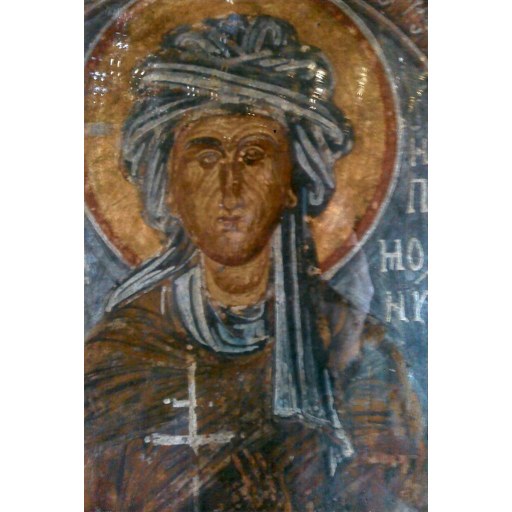
Dr Dimitrios - James Manos
License: Public domain
Helena Dragaš
Venerable- Life Span
- d. 1450
- Feast Day
- 29 May
- Gender
- female
- Church
- Catholic
Places
Roles & Family
Religious Information
Biography
Helena Dragaš (Serbian Jelena Dragaš) was a Serbian noblewoman who became empress consort of the Byzantine Empire as the wife of Manuel II Palaiologos, and who is venerated in the Eastern Orthodox Church under her monastic name, Saint Hypomone. She was the daughter of Constantine Dragaš (Konstantin Dejanović), a leading Serbian magnate of the later fourteenth century. After the disintegration of centralized Nemanjić rule, Constantine governed a substantial principality in eastern Macedonia, centered on Velbazhd (modern Kyustendil), holding his lands as a vassal of the Ottoman sultan, as did many Christian lords of the region. Helena’s mother is not securely named in the surviving sources. Her own date and place of birth are likewise unrecorded; historians conventionally place her birth in the early 1370s in her father’s Macedonian domains. She thus belonged to the Serbian high nobility at a moment when Ottoman expansion was rapidly recasting the political map of the Balkans. Constantine himself later fell at the Battle of Rovine in 1395 while campaigning in Ottoman service.
In February 1392 she married Manuel II Palaiologos in Constantinople. Manuel had become sole emperor in 1391 upon the death of his father, John V Palaiologos. The marriage was a dynastic alliance between the Palaiologoi and a still-influential Serbian house at a time when Byzantium was already a territorially reduced state. Helena and Manuel had a large family. Sons who reached adulthood included John, later Emperor John VIII Palaiologos; Constantine, who reigned as Constantine XI Palaiologos and died in the Ottoman capture of Constantinople in 1453; Theodore, despot of the Morea; Andronikos Palaiologos, associated with the government of Thessalonica; Demetrios Palaiologos; and Thomas Palaiologos, also a despot in the Peloponnese. Daughters are also attested. The couple therefore supplied the last generation of Palaiologos rulers in both the capital and the Byzantine Morea. As empress, Helena lived through the Ottoman blockade of Constantinople in the last years of the fourteenth century and through Manuel II’s long journey to Italy, France, and England (1399–1403), undertaken in the hope of obtaining Western military aid. During that absence John VII Palaiologos acted as regent in the capital. Contemporary and later Byzantine writers, among them George Sphrantzes, present Helena as pious, prudent, and of firm character, a reputation that underpinned her standing at court.
After Manuel II died in 1425, Helena adopted the monastic habit and the name Hypomone, the Greek word for patience or patient endurance. Monastic retirement did not erase her influence. She remained a figure of moral and familial authority during the reign of John VIII and in the first years of Constantine XI, in a period marked by Ottoman pressure, Palaiologos family rivalries, and the empire’s desperate diplomacy toward both the Ottomans and the Latin West. Sources do not preserve a detailed political program in her own voice, and her precise views on questions such as union with the Church of Rome are not clearly documented. What the tradition consistently emphasizes is her piety, her role as mother of the last emperors, and the respect accorded her in the palace and the Church.
She died in Constantinople on 23 March 1450, three years before the city’s fall. The Eastern Orthodox Church honors her as Saint Hypomone. Her principal feast day is 29 May, a date that Orthodox memory also associates with the fall of Constantinople and with the death of her son Constantine XI. Early narrative sources do not preserve a full medieval saint’s life, and details of her burial and of any formal act of glorification are sparse; her cult is that of a holy empress and nun rather than of a figure with an extensive contemporary hagiographical dossier. In later Orthodox devotion, especially in Greek-speaking communities, she is remembered as a model of patience and as the mother of the last Byzantine emperor.