Heliodorus of Altino is a saint of the Catholic Church. Heliodorus of Altino's feast day is celebrated on 3 July. Heliodorus of Altino is the patron saint of Torcello;Altino.
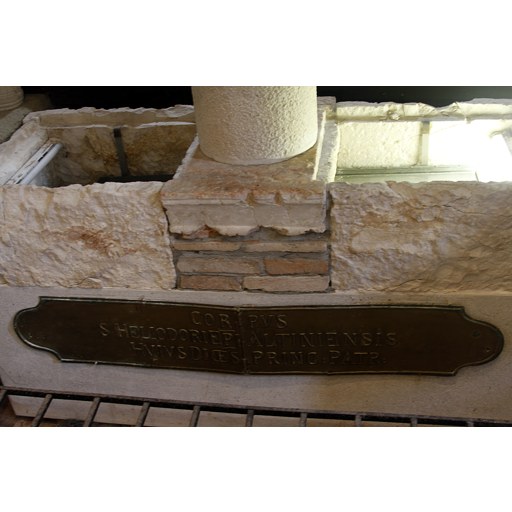
José Luiz
License: CC BY-SA 4.0
Heliodorus of Altino
Saint- Feast Day
- 3 July
- Gender
- male
- Church
- Catholic
Places
Roles & Family
Patronage
Torcello;Altino
Biography
Heliodorus of Altino, known in Latin as Heliodorus and in Italian as Eliodoro di Altino, was a fourth-century Christian bishop venerated as a saint. He is regarded as the first historically documented bishop of Altinum, a Roman city on the Venetian mainland whose site corresponds to modern Altino in northeastern Italy. Tradition holds that he was a native of Dalmatia, a Roman province on the eastern Adriatic. Before entering ecclesiastical life he is said to have served as a soldier. He then adopted an ascetic and monastic way of life and formed a close friendship with Jerome of Stridon, the biblical scholar and future Doctor of the Church. Their association is among the best-attested features of Heliodorus's career because it is reflected in Jerome's surviving correspondence and prefaces.
Jerome addressed Heliodorus in an early hortatory letter that urged him to persevere in the monastic calling. Heliodorus had traveled toward the East with Jerome but returned to the West, apparently in order to attend to family obligations. Those obligations included care for his nephew Nepotian, the son of Heliodorus's sister, who later served as a priest in the church of Altinum and died while still a young man. Jerome's Letter 60, a consolation written to Heliodorus after Nepotian's death and generally dated to the mid-390s, remains a principal source for the family's circumstances and for Heliodorus's standing as a bishop of austere life. The letter shows Heliodorus still alive and in office at that date, which is important for any attempt to reconstruct his chronology.
As bishop of Altinum, Heliodorus belonged to the Nicene episcopate of northern Italy, in a region whose metropolitan center was Aquileia. Later tradition presents him as a defender of orthodox doctrine against Arianism and as a promoter of clerical and monastic discipline, in keeping with the ideals shared by Jerome and by other Italian churchmen of the period. Jerome jointly addressed to Chromatius of Aquileia and to Heliodorus the preface to his Latin translation of the Books of Solomon (Proverbs, Ecclesiastes, and the Song of Songs), a dedication that confirms Heliodorus's reputation as a learned and trusted colleague in the closing years of the fourth century. Precise years for his consecration and for most of his episcopal acts are not preserved in contemporary records.
The exact year of Heliodorus's death is not securely known. Later hagiographical notices often place it near the end of the fourth century, but Jerome's letters and prefaces show that Heliodorus was still living in the later 390s. He is believed to have died at Altinum. In subsequent centuries, as Altinum declined after invasions and as population shifted into the Venetian Lagoon, his relics were translated to the island of Torcello, where he became a principal local patron. His feast is kept on 3 July. Apart from Jerome's writings and the later cult at Torcello and in the Venetian church, independent contemporary documentation of his life is limited, and many details repeated in medieval and modern saint legends cannot be verified from early sources.