Heliodorus is a saint of the Catholic Church. Heliodorus's feast day is celebrated on 3 July. Heliodorus is the patron saint of Altino.
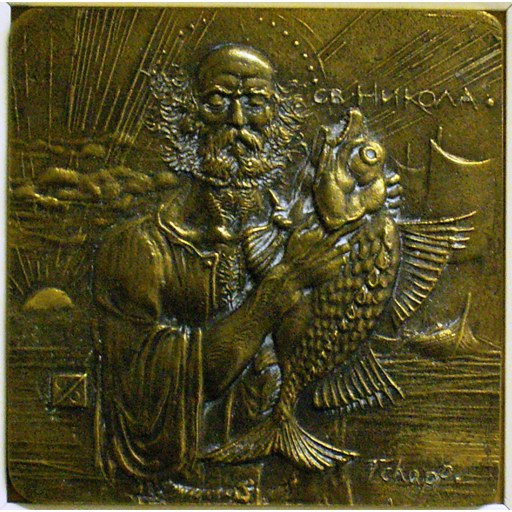
https://en.wikipedia.org/wiki/Icon
License: unknown
Heliodorus
Saint- Feast Day
- 3 July
- Gender
- male
- Church
- Catholic
Places
Roles & Family
Patronage
Altino
Biography
Heliodorus of Altinum (Italian: Sant'Eliodoro) was a fourth-century bishop in northern Italy, known principally as a friend and correspondent of Saint Jerome and as the first historically attested bishop of Altinum (modern Altino, in the hinterland of the Venetian lagoon). Almost nothing can be verified about his parentage, childhood, or the exact place and date of his birth. Later tradition often calls him a native of Dalmatia, which would fit the Illyrian and north-Adriatic background of several members of Jerome's circle, but that origin is not independently documented and should be treated as traditional rather than proven. He enters the surviving record in the 370s as part of the ascetic group connected with Aquileia, together with men such as Chromatius, Rufinus, and Jerome.
Heliodorus embraced the monastic and clerical reform current of his generation. He accompanied Jerome toward the East but did not remain in the Syrian desert. Jerome's Letter 14, written from the desert of Chalcis in the mid-370s, is a well-known exhortation pressing Heliodorus to leave family obligations and Italian prospects and to return to the eremitical life. Heliodorus instead took up pastoral office at home and became bishop of Altinum, a Roman municipium of Venetia in the orbit of the metropolitan church of Aquileia. As bishop he was associated with the promotion of ascetic standards among the clergy. His nephew Nepotianus (Nepotian) was ordained priest and held up as a model of that new clerical piety. After Nepotian's early death, Jerome addressed to Heliodorus the long consolatory Letter 60, commonly dated to 396, which is the chief narrative source for Heliodorus's later years and for the spiritual tone of the north-Italian episcopate at the end of the century.
His episcopate coincided with doctrinal aftershocks of the Arian controversy and with growing political strain along the Venetian shore, but the evidence does not support a detailed reconstruction of his synodal activity, administrative acts, or day-to-day governance. He was certainly still alive in the mid-390s, when Jerome wrote to him as a sitting bishop; older notices that place his death in 390 are therefore incompatible with the correspondence. He most probably died at Altinum in the last years of the fourth century or the first years of the fifth. No contemporary vita survives. Knowledge of him depends overwhelmingly on Jerome's letters and on the later continuity of a local cult.
That cult is ancient. When Altinum declined and was largely abandoned in the early Middle Ages, as settlement moved into the lagoon, his relics were translated to the island of Torcello. A sarcophagus traditionally identified as his is preserved in the Cathedral of Santa Maria Assunta there, which became the main focus of his veneration. The Roman Martyrology commemorates him on 3 July as bishop of Altinum, distinguished for holiness. He is invoked as patron of Altino and is remembered in Venetian ecclesiastical tradition as an early pastor of the lagoon churches. There is no medieval bull of canonization; his sainthood belongs to the ancient, pre-congregational cultus of a local holy bishop later received into wider martyrologies. Precise birth and death years, a verified birthplace, and any extended list of patronages beyond Altino itself are not recoverable from reliable sources.