Henry II the Pravoslav is a servant of god of the Catholic Church (d. 1241).
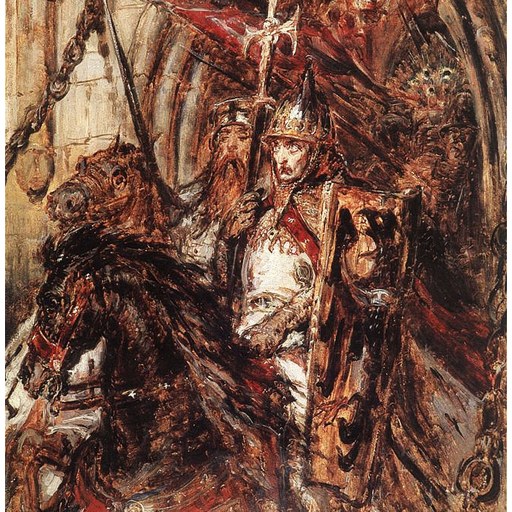
Jan Matejko
License: Public domain
Henry II the Pravoslav
Servant of God- Life Span
- d. 1241
- Gender
- male
- Church
- Catholic
Places
Relics & Where to Venerate
Location unknown
The bodily remains of Henry II the Pious are a first-class relic. Venerated at Wrocław.
Roles & Family
Religious Information
Biography
Henry II, known as the Pious (Polish: Henryk II Pobożny; German: Heinrich der Fromme), was a duke of the Silesian line of the Piast dynasty and High Duke of Poland in the first half of the thirteenth century. He was the son of Henry I the Bearded, Duke of Silesia and later High Duke of Poland, and Hedwig of Andechs, a noblewoman of the House of Andechs who was later canonized as Saint Hedwig of Silesia. He was born in the late twelfth or very early thirteenth century in his father's Silesian domains; surviving sources do not fix a single undisputed year of birth. An elder brother, Bolesław, died in childhood, so Henry became the principal heir. He was raised at a court that mixed Piast political custom with close ties to German and Bohemian elites and with a strongly religious household atmosphere shaped by his mother. From the 1220s he was associated with his father's government and appears as co-ruler in Silesia and in the Polish seniorate lands that Henry I had gathered.
When Henry I the Bearded died in 1238, Henry II inherited a large composite principality: the Duchy of Silesia, the Seniorate Province with Kraków, and substantial holdings in Greater Poland. That inheritance made him High Duke of Poland and the most powerful Piast prince of his generation. He continued his father's efforts to strengthen ducal authority, to promote settlement and urban growth (including German colonization and the spread of towns under German law), and to patronize the Latin Church. He maintained close relations with Cistercians, Franciscans, and other orders favored by his parents. His epithet reflects both personal devotion and the public stance of a Christian ruler rather than membership in a religious order. Around the mid-1210s he married Anna, daughter of King Ottokar I of Bohemia, binding the Silesian Piasts to the Přemyslid dynasty. They had many children, among them Bolesław II the Horned, Henry III the White, Konrad of Głogów, and Władysław, later Archbishop of Salzburg, as well as daughters married into neighboring princely houses.
Henry's relatively short sole reign was overtaken by the Mongol assault on Central Europe. In 1240–1241 Mongol forces operating as a northern wing of the invasion of Hungary entered Poland. Henry tried to assemble Polish dukes, Moravian contingents, and brethren of the military orders, including Templars and Hospitallers. On 9 April 1241 he met the Mongol commanders active in this theater—Baidar, Kadan, and Orda—on the field at Legnickie Pole near Legnica (historically also called Wahlstatt or Liegnitz). The Christian army was defeated and Henry was killed. Later accounts state that his body was stripped and mutilated and that his head was displayed on a spear; his widow Anna is said to have identified the corpse by a congenital mark, often described as an extra toe on one foot.
The political consequences were immediate. Henry's lands were divided among his sons, which sped the breakup of Silesia into many duchies and weakened Piast control of Kraków and Greater Poland. The Mongols did not occupy Silesia for long; they withdrew in the wider context of the Hungarian campaign and the succession crisis after the death of Great Khan Ögedei. Henry was buried in Wrocław in the Franciscan church of Saint James, later known as the church of Saint Vincent. He was never formally beatified or canonized by the Roman Church, but his death in battle against a non-Christian invader, together with the sanctity of his mother Hedwig, sustained a local memory of him as a Christian prince and martyr. Anna of Bohemia remained important during their sons' minorities and in the religious patronage of thirteenth-century Silesia.