Henry Morse is a saint of the Catholic Church (1595 - 1645). Henry Morse's feast day is celebrated on 1 February.
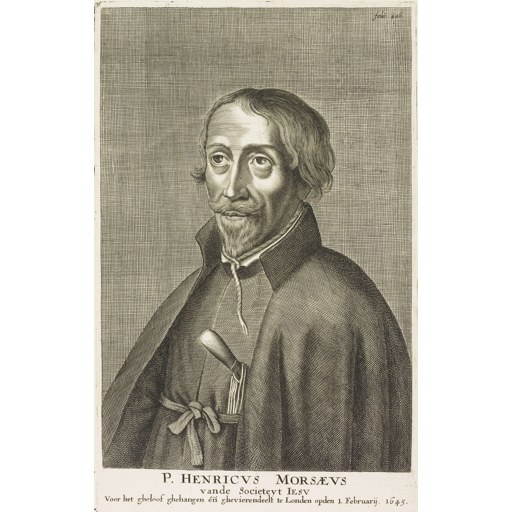
Morsaeus, Henricus (-1645) (depicted)
License: Public domain
Henry Morse
Saint- Life Span
- 1595 - 1645 (age 50)
- Feast Day
- 1 February
- Gender
- male
- Church
- Catholic
Places
Roles & Family
Religious Information
Canonization
Biography
Henry Morse was born in 1595 at Brome in Suffolk, in the Kingdom of England, to a Protestant family. Little is recorded of his childhood, but as a young man he went to London to study law. While there he became convinced of the truth of the Catholic faith and was received into the Roman Catholic Church. In the early seventeenth century such a conversion carried serious legal and social consequences in England, where the practice of Catholicism was restricted by a body of penal statutes and where ordination as a Catholic priest, followed by return to the country, had been declared high treason. Morse left England to train for the priesthood at the English College at Douai in the Spanish Netherlands and later at the English College in Rome. He was ordained a priest in the 1620s and sent back to his native country as a missionary.
Upon returning to England he was soon arrested for his priesthood and imprisoned, spending a substantial period in confinement before being banished. During this phase of his life he sought admission to the Society of Jesus and completed his novitiate and formation in the Low Countries. As a Jesuit he returned again to the English mission, working chiefly in and around London. The city in the 1630s was subject to recurrent outbreaks of plague. During the severe epidemic of the mid-1630s Morse devoted himself to the spiritual and corporal care of the sick, especially among the poor of the parish of St Giles-in-the-Fields, a crowded district outside the western walls of the City of London. He laboured in close association with other Catholic priests who likewise risked infection and arrest. Morse himself fell ill with the plague but recovered and resumed his work.
His public charity made him more conspicuous to the authorities. He was arrested once more and imprisoned, including a period in Newgate, one of London’s principal gaols. After further banishment he again re-entered England and continued missionary activity, this time in the north of the country. The 1640s brought the English Civil War, which intensified religious and political tensions. Morse was captured, conveyed to London, and put on trial at the Old Bailey. The charge against him was that of being a Catholic priest ordained abroad who had returned to England, an offence that the Elizabethan statute of 1585 treated as high treason. He was found guilty and sentenced to the traitor’s death of hanging, drawing, and quartering.
On 1 February 1645 Morse was executed at the Tyburn gallows on the outskirts of London. Contemporary Catholic accounts record that he met his death with composure and that he declared he died for the Catholic religion. He was about fifty years of age. In the twentieth century the Catholic Church formally recognized his martyrdom. Pope Pius XI beatified him in 1929 among a large group of English and Welsh martyrs. On 25 October 1970 Pope Paul VI canonized him as one of the Forty Martyrs of England and Wales, a representative group chosen from among the many Catholics put to death in England and Wales between the reign of Henry VIII and that of Charles II. Morse’s individual feast day is 1 February, the date of his execution; he is also commemorated with the other Forty Martyrs. His life is that of a convert, Jesuit missionary, and pastor of plague victims who was put to death under the penal laws for the exercise of his priesthood.