Henry of Segusio is a blessed of the Catholic Church (d. 1271).
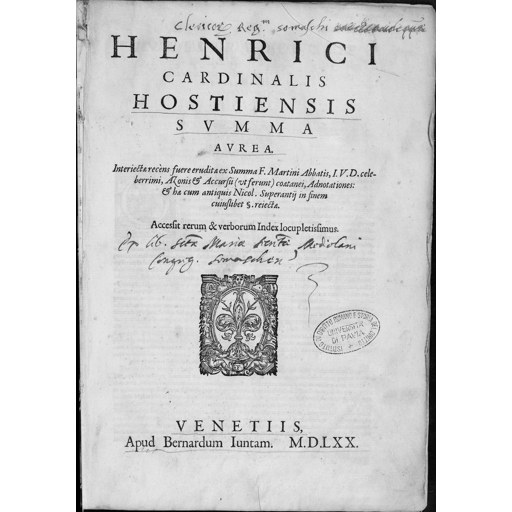
Enrico da Susa
License: Public domain
Henry of Segusio
Blessed- Life Span
- d. 1271
- Gender
- male
- Church
- Catholic
Places
Roles & Family
Biography
Henry of Segusio, known to later generations as Hostiensis from the suburbicarian see of Ostia which he held as cardinal, was among the foremost canon lawyers of the thirteenth century. He was born at Susa (Latin Segusium) in Piedmont, in the northwest of the Italian peninsula. Surviving sources do not record an exact year of birth; modern reference works place it around the beginning of the thirteenth century. He studied both civil and canon law, in all probability at Bologna, then the principal European school of jurisprudence. The combination of the two laws remained characteristic of his teaching and of his written work.
After his studies he taught canon law, notably at Paris, and held the dignity of archdeacon of Paris. In 1244 he was provided to the bishopric of Sisteron in Provence. About 1250 he was promoted to the metropolitan see of Embrun in the French Alps. These Provençal and Alpine appointments placed him within the orbit of the papal curia and of the political world of Provence and Savoy. In 1262 Pope Urban IV named him Cardinal-Bishop of Ostia and Velletri, the senior suburbicarian see. From that title he took the name Hostiensis by which he is still commonly known. As a cardinal he took part in the affairs of the Roman Church under Urban IV and Clement IV and during the long vacancy that followed Clement’s death in 1268.
His reputation rests above all on his legal writings. The Summa super titulis Decretalium, often called the Summa aurea or Golden Summa, offered a systematic treatment of the titles of Gregory IX’s Liber Extra and became a standard textbook. A more ample Lectura on the same decretals preserves his fuller arguments and many of his personal opinions, including a strong doctrine of papal plenitude of power. He also wrote an apparatus on the Novellae of Innocent IV. In these works he discussed the legal status of non-Christians, vows and crusading obligations, the just war, and countless points of procedure and ecclesiastical administration. Manuscripts of his commentaries spread through the universities and church courts of the Latin West and continued to be cited by later decretalists.
He died at Lyon in 1271, during the prolonged papal interregnum that ended with the election of Gregory X. Medieval notices of the precise day are not uniform, ranging from late October to early November of that year. He was not canonized or beatified, and no liturgical feast or recognized patronage is attached to him. His enduring place in the history of the Church is that of a jurist whose commentaries shaped later understanding of papal authority and of the ius commune.