Henry Suso is a blessed of the Catholic Church (d. 1366). Henry Suso's feast day is celebrated on 23 January.
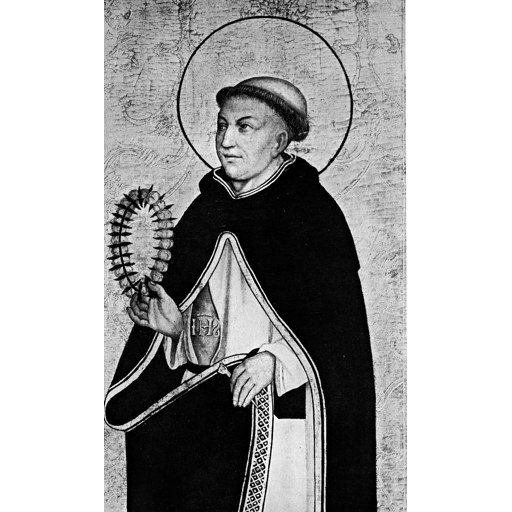
unknown painter
License: Public domain
Henry Suso
Blessed- Life Span
- d. 1366
- Feast Day
- 23 January
- Gender
- male
- Church
- Catholic
Places
Relics & Where to Venerate
Location unknown
The bodily remains of Henry Suso are a first-class relic. Venerated at Baden-Württemberg.
Roles & Family
Religious Information
Canonization
Biography
Henry Suso, known in German as Heinrich Seuse and in some of his own writings as Amandus, was a Dominican friar and mystic of the fourteenth-century Rhineland, commonly grouped with Meister Eckhart and Johannes Tauler. He was born Heinrich von Berg in the Lake Constance region of Swabia, within the Holy Roman Empire, in the closing years of the thirteenth century. Later tradition often repeats a date around 1295 and assigns the birth either to Constance or to nearby Überlingen; neither the exact year nor the town can be fixed with certainty from surviving evidence. His father belonged to the knightly von Berg family; his mother came from the family called Süs or Sus, whose name the son adopted. At about the age of thirteen he entered the Dominican convent at Constance.
After his early formation he studied at the Dominican studium generale in Cologne, where he heard Meister Eckhart. The condemnation in 1329 of a list of propositions drawn from Eckhart’s teaching left Suso in a difficult position. He continued to revere his master and to transmit a doctrine of detachment and of the birth of God in the soul, but he recast that teaching in more affective and cautiously orthodox language. In his younger years he practiced severe bodily penances, including a hair shirt, a nail-studded undergarment, and a wooden cross fitted with iron nails; he also cut the sacred monogram of Jesus into the flesh of his chest. Later visions and the counsel of superiors led him to abandon the most extreme external austerities in favor of interior resignation of the will.
His surviving works made him one of the most widely read vernacular spiritual authors of the later Middle Ages. The Little Book of Truth treats speculative mysticism in dialogue form. The Little Book of Eternal Wisdom, a series of meditations on the Passion and on Eternal Wisdom as bridegroom of the soul, was later expanded by Suso himself into the Latin Horologium Sapientiae, which circulated throughout Europe. An account of his inner and outer life, known as The Life of the Servant, was prepared with the help of Elsbeth Stagel, a Dominican nun of Töss who collected his letters and reminiscences. Modern scholarship treats that Vita as a mixture of historical memory and hagiographical construction intended to form the reader rather than as a straightforward chronicle.
Suso served as prior in Constance and as a preacher and director of nuns and tertiaries along the Upper Rhine. He suffered accusations of doctrinal error in the aftermath of Eckhart’s trial and a public scandal in which he was falsely said to have fathered a child. These troubles, together with political tensions in the city, led to his departure from Constance. After a period of itinerant preaching he settled in the Dominican house at Ulm, where he died on 25 January 1366 and was buried in the convent church. Pope Gregory XVI confirmed his cult and beatified him in 1831. He remains an important witness to German Dominican mysticism, notable for joining speculative insight to a vivid, often bridal, devotion to the suffering Christ.