Heribert of Cologne is a saint of the Catholic Church (d. 1021). Heribert of Cologne's feast day is celebrated on 16 March. Heribert of Cologne is the patron saint of Deutz;rain;against drought.
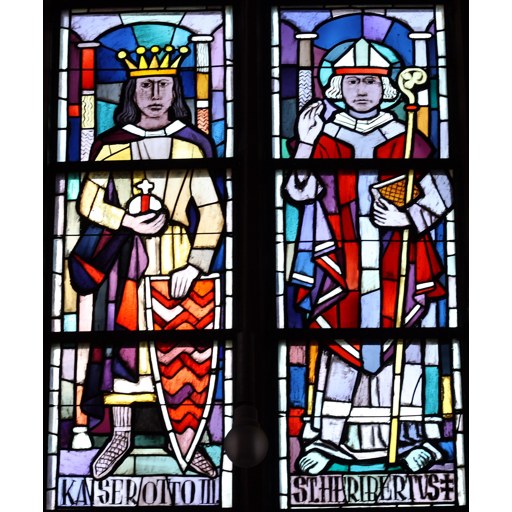
User:Reinhardhauke
License: CC BY-SA 3.0
Heribert of Cologne
Saint- Life Span
- d. 1021
- Feast Day
- 16 March
- Gender
- male
- Church
- Catholic
Places
Relics & Where to Venerate
Location unknown
The bodily remains of Heribert of Cologne are a first-class relic. Venerated at Deutz Abbey.
Location unknown
His remains were enshrined in a golden reliquary at Deutz Abbey on 30 August 1147
Roles & Family
Patronage
Deutz;rain;against drought
Canonization
Biography
Heribert of Cologne, venerated as a saint in the Catholic Church, was a leading prelate of the Ottonian empire and Archbishop of Cologne at the turn of the eleventh century. He was born at Worms in the later tenth century, the son of Count Hugo of Worms. After elementary formation at the cathedral school of Worms he continued his studies at the Benedictine abbey of Gorze in Lorraine, then an influential house of monastic reform. Returning to his native city, he entered the cathedral clergy and rose to become provost of the chapter of Worms, a position that placed him among the more important clerics of the Rhineland.
His abilities brought him to the attention of the imperial court. In 994 Emperor Otto III named him chancellor for the kingdom of Italy, and he soon exercised the same office for Germany, becoming one of the young emperor’s principal counselors and a central figure in the itinerant government of the realm. In 999, while Heribert was with Otto III in Italy, the cathedral chapter of Cologne elected him archbishop. Still in deacon’s orders at the time of his election, he was ordained priest and consecrated bishop and received the pallium from Pope Sylvester II. He continued to serve the emperor closely and was among those present when Otto III died at Paterno in January 1002. Heribert then took a leading part in conveying the emperor’s body back across the Alps for burial at Aachen and in safeguarding the imperial insignia during the uncertain succession that followed.
The accession of Henry II as king produced a period of strain between the new ruler and the archbishop of Cologne, who had not been among Henry’s earliest supporters. In time the two were reconciled, and Heribert retained his see and his influence in the church of the empire. As archbishop he governed a vast diocese that stretched across much of northwestern Germany and into the Low Countries. His most enduring foundation was the Benedictine abbey he established at Deutz, on the opposite bank of the Rhine from Cologne, in the first years of the eleventh century. The house was dedicated to the Virgin Mary and became both a center of Benedictine life and the place he chose for his own burial. Contemporary and later tradition emphasized his personal austerity, his care for the liturgy, and his open-handed charity to the poor. A well-known story associated with his cult recounts that, during a severe drought, his prayers obtained rainfall for the region.
Heribert died on 16 March 1021 and was interred in the abbey church at Deutz. Devotion at his tomb grew during the eleventh century, and Pope Gregory VII is reported to have canonized him around 1074. His principal feast is observed on 16 March. He is regarded as a patron of Deutz and has traditionally been invoked for rain and against drought. In the twelfth century his relics were enclosed in a richly decorated golden shrine, the Heribertshrein, which remains in the church of Saint Heribert in Cologne-Deutz and is an important work of Mosan goldsmiths’ art.