Hermagoras is a saint of the Catholic Church. Hermagoras's feast day is celebrated on 12 July. Hermagoras is the patron saint of Aquileia;Udine;Archdiocese of Udine;Archdiocese of Gorizia.
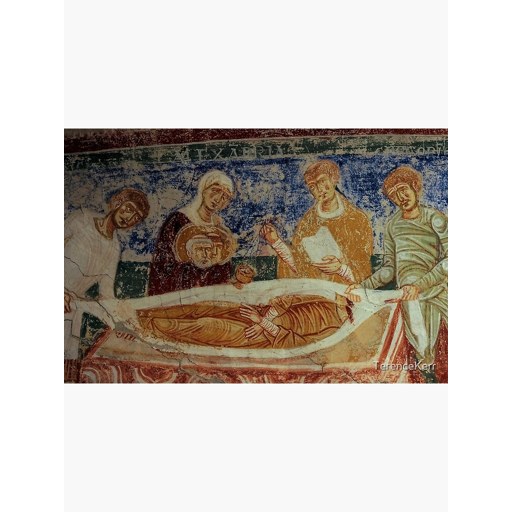
https://www.redbubble.com/i/poster/Burial-of-Saint-Hermagoras-or-Santo-Ermacora-by-TerenceKerr/160808761.LVTDI
License: unknown
Hermagoras
Saint- Feast Day
- 12 July
- Gender
- male
- Church
- Catholic
Places
Roles & Family
Patronage
Aquileia;Udine;Archdiocese of Udine;Archdiocese of Gorizia
Biography
Hermagoras (Latin Hermagoras; Italian Ermagora; Slovene Mohor) is venerated in the Latin Church as a martyr and, in later ecclesiastical tradition, as the first bishop of Aquileia in northeastern Italy. He is commemorated together with the deacon Fortunatus. The Roman Martyrology records them on 12 July at Aquileia. No contemporary narrative, inscription, or administrative document preserves a birth year, birthplace, family, or career independent of later legend. The earliest substantial liturgical witness is the Martyrologium Hieronymianum, a late antique compilation, which already associates the two names with Aquileia on that date. Beyond that cultic notice, the biographical dossier is almost entirely hagiographical.
The extended life of Hermagoras belongs to a Passio written centuries after the events it claims to describe and generally dated by scholars somewhere between late antiquity and the early Middle Ages. In that account the Evangelist Mark, having preached at Aquileia, chose Hermagoras to lead the new community and brought him to Rome, where the Apostle Peter consecrated him bishop. Hermagoras then returned to Aquileia, evangelized the surrounding region of Venetia, and ordained Fortunatus deacon. During a persecution linked in the text to the emperor Nero, a local official had both men arrested, tortured, and beheaded. The legend served to give the church of Aquileia an apostolic foundation comparable to those claimed by other major sees and to present Hermagoras as the fountainhead of its later metropolitan and patriarchal pretensions.
Critical history does not accept this first-century episcopate as fact. Aquileia was a major Christian centre by the fourth century, with a large basilica complex and bishops who took part in the conciliar life of the late Roman church, but there is no reliable evidence for a bishop named Hermagoras in the apostolic age, nor for a Petrine or Marcan foundation of the see. The historically attested episcopal list of Aquileia begins much later. It is possible that Hermagoras and Fortunatus were real martyrs of a later persecution whose names survived in local memory and were then written into an apostolic origin story, a pattern familiar in early medieval hagiography. The patriarchal title of Aquileia itself arose only in the sixth century and after, in the context of the Three Chapters controversy and the rivalry with Grado; it should not be read back onto Hermagoras as an office he actually held.
The cult of Hermagoras and Fortunatus became central to the religious identity of Friuli and neighbouring regions. Their relics were associated with Aquileia; after the city’s destruction and the later shifts of the see, veneration continued at Grado and, in the Middle Ages, at Udine, whose cathedral became a principal shrine. In the Slovene lands the saint is known as sveti Mohor and, with Fortunatus (sveti Fortunat), ranks among the most popular regional patrons; the nineteenth-century Catholic publishing house Mohorjeva družba (Hermagoras Society) took his name. He is honoured as a patron of Aquileia and of Udine, and with Fortunatus as patron of the Archdioceses of Udine and Gorizia. No papal act of canonization is recorded; the cult is of the ancient, pre-congregational type. Birth, marriage, children, and a precise year of death are unknown and cannot be supplied from the legendary Passio.