Herman I, Margrave of Baden is a blessed of the Catholic Church (d. 1074).
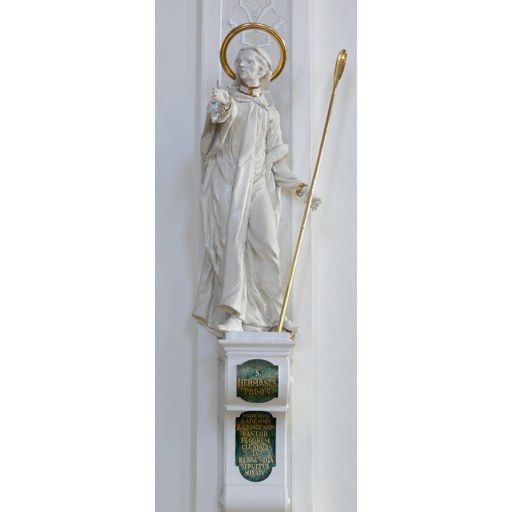
Photo: Andreas Praefcke
License: CC BY 3.0
Herman I, Margrave of Baden
Blessed- Life Span
- d. 1074
- Gender
- male
- Church
- Catholic
Places
Relics & Where to Venerate
Location unknown
The bodily remains of Herman I, Margrave of Baden are a first-class relic. Venerated at Cluny Abbey.
Roles & Family
Religious Information
Biography
Herman I of Baden was an eleventh-century nobleman of the Zähringen kindred in Swabia, remembered as the ancestor of the margraves of Baden. He is commonly described as count in the Breisgau and as titular margrave of Verona. He was the eldest son of Berthold I of Zähringen, who in 1061 received the duchy of Carinthia and the march of Verona after failing to obtain the duchy of Swabia. The year and place of Herman’s birth are not recorded in contemporary sources; later estimates that place his birth around the middle of the eleventh century remain conjectural. Like many counts of his generation, he appears only intermittently in the surviving documentation, and much of the traditional picture of his life has been reconstructed from later house chronicles and from the better-attested careers of his father and his son.
The Zähringen family stood among the foremost dynasties of the southwest of the German kingdom. Berthold’s Carinthian and Veronese titles gave his sons a claim to rank as margraves, even though effective power in northeastern Italy was limited. Herman’s own sphere of action lay chiefly in Swabia, especially in the Breisgau on the upper Rhine. The political background of his adulthood was the reign of Henry IV and the gathering conflict between the Salian court and the south German princes, but Herman himself is not a prominent figure in the narrative sources of the Saxon War or the early Investiture Controversy.
Herman’s marriage to Judith of Backnang, also known as Judith of Backnang-Sulichgau, brought him a significant inheritance in the middle Neckar country and adjacent parts of Swabia. Those lands, centred on Backnang, complemented his Breisgau county and later formed one of the building blocks of the margraviate of Baden. The name Baden itself, taken from the castle and baths in the Oos valley, came into regular dynastic use in the next generation. Herman and Judith had at least one son, Herman II, who succeeded to the family possessions and is generally regarded as the first to employ the title Margrave of Baden in a settled way. Some genealogical accounts also assign them a daughter named Judith. The religious house of regular canons later established at Backnang, drawing on Judith’s inheritance, became a principal burial place of the early margraves, though the formal foundation belongs to the early twelfth century rather than to Herman I’s own lifetime.
Toward the end of his life Herman withdrew from secular affairs and entered the Benedictine abbey of Cluny in Burgundy, then under Abbot Hugh and at the height of its reforming influence. Retirement of high nobles to Cluny was a recognized pattern in the era of church reform. He died at Cluny on 25 April 1074. No contemporary narrative of his monastic years survives, and it is not certain where he was buried, though death in the abbey makes Cluny the most plausible place of interment.
Herman I was never the object of a canonization process, liturgical feast, or popular cult, and he is not counted among the saints. His importance is dynastic and territorial: he transmitted Zähringen rank and Swabian lands to a line that, under his son and grandsons, took the name of Baden and endured as a princely house of the Holy Roman Empire. The documentary basis for his biography remains thin; statements about his birth, the exact extent of his counties, and the details of his last years depend on later tradition as much as on eleventh-century charters.