Herman of Valaam is a saint of the Catholic Church. Herman of Valaam's feast day is celebrated on June 28 and September 11. Herman of Valaam is the patron saint of Valaam Monastery.
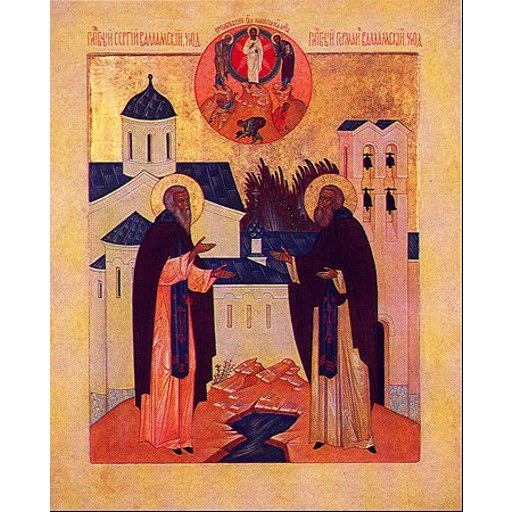
Unknown authorUnknown author
License: Public domain
Herman of Valaam
Saint- Feast Day
- June 28 and September 11
- Gender
- male
- Church
- Catholic
Places
Roles & Family
Religious Information
Patronage
Valaam Monastery
Biography
Herman of Valaam, also known in Slavic sources as German of Valaam, is an Eastern Orthodox monastic saint traditionally honored, together with Saint Sergius of Valaam, as a founder of the Valaam Monastery on Valaam Island in Lake Ladoga. No contemporary Life or chronicle entry for Herman has survived, and the details of his biography rest on later hagiographical compilations. Those traditions commonly describe Herman and Sergius as Greek monks who came from the Byzantine Empire, sometimes from Constantinople or from a community associated with Mount Athos, and who settled on the islands of Lake Ladoga in order to pursue the eremitical life and to preach Christianity among the Karelian peoples of the northern forests.
The chronology of their work is uncertain and remains a subject of scholarly disagreement. Russian Orthodox memory has often assigned the foundation of Valaam to the tenth century, linking it with the wider Christianization of Rus and with early missions in Karelia. Other accounts place the saints in the twelfth century or in the fourteenth. A sixteenth-century tradition reported that their relics were found and translated in 1163. Independent documentary evidence for the monastery itself appears only toward the end of the fourteenth century and the beginning of the fifteenth, which has led many historians to treat a very early date as unproven. No reliable year of birth or of death for Herman can be established from the sources, and neither a birthplace nor a family origin can be verified beyond the conventional claim of Greek monastic background.
Within the tradition, Herman and Sergius are said to have gathered disciples, instituted a common monastic rule of Eastern Orthodox type, and made Valaam a center of prayer and missionary activity on the frontier between the Novgorod lands and Karelia. Herman is not remembered as a bishop, patriarch, or pope, nor as a married man; he is consistently presented as a monk. Individual deeds attributed to him apart from those he shares with Sergius are few and cannot be corroborated. The later fame of Valaam—its strict discipline, its role as a mother house, and, in a much later age, its connection with the Russian mission to Alaska, from which Saint Herman of Alaska took his monastic formation—belongs to the history of the community rather than to the documented life of the medieval founder.
Liturgical veneration of Sergius and Herman developed at Valaam and was received throughout the Russian Orthodox Church and related Orthodox churches, including the Finnish Orthodox Church, which had close historical ties to the monastery. Their relics were preserved at the monastery and attracted pilgrims. The principal feast days are 28 June, commemorating the translation of the relics, and 11 September, commemorating their repose, according to the Julian calendar of the Russian service books. They are also remembered in the Synaxis of All Saints of Valaam. The monastery suffered destruction and restoration several times, notably during wars between Novgorod or Muscovy and Sweden and again in the twentieth century, when the community was evacuated and later returned. Through these vicissitudes Herman of Valaam has continued to be invoked as a heavenly patron of the island monastery, even while historians acknowledge that the personal facts of his life remain largely beyond recovery.