Hermenegild is a saint of the Catholic Church (d. 585). Hermenegild's feast day is celebrated on 13 April.
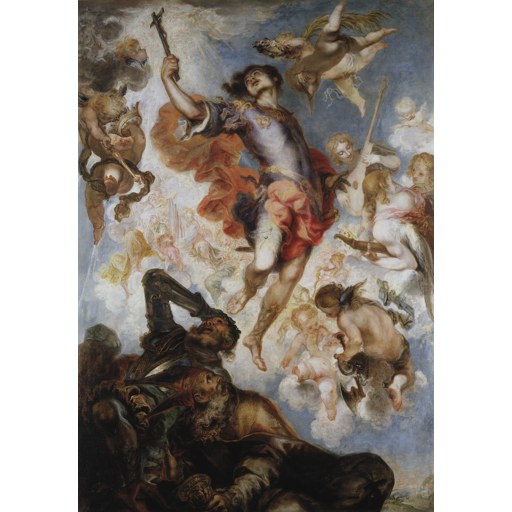
Francisco Herrera the Younger
License: Public domain
Hermenegild
Saint- Life Span
- d. 585
- Feast Day
- 13 April
- Gender
- male
- Church
- Catholic
Places
Roles & Family
Religious Information
Biography
Hermenegild was a Visigothic prince of the sixth century, the son of King Leovigild, who ruled the Visigothic kingdom in Hispania, and the elder brother of Reccared, who later succeeded their father. Raised at the royal court in an Arian Christian environment, then the faith of the Visigothic ruling elite, he belonged to a dynasty that had long remained separate in religion from the Hispano-Roman majority, who adhered to Nicene (Catholic) Christianity. Contemporary and near-contemporary writers, including Gregory of Tours, John of Biclaro, Isidore of Seville, and Pope Gregory the Great, are the principal sources for his life; they do not record a precise place or year of birth. Later tradition sometimes associated his family with the circle of the Hispano-Roman bishops Leander and Isidore of Seville, but that kinship is not securely established in the earliest evidence.
In the later 570s Leovigild arranged Hermenegild’s marriage to Ingund (Ingunda), a Frankish princess and daughter of the Austrasian king Sigebert I and Queen Brunhilda. Ingund had been raised in the Catholic faith, and the marriage brought a Nicene Christian into the heart of the Arian court. Tension followed, especially with Leovigild’s second wife, Goiswintha, who according to Gregory of Tours treated Ingund with hostility over religion. Under the influence of his wife and of Leander, the Catholic bishop of Seville, Hermenegild accepted Catholic baptism and abandoned Arianism. The conversion, which took place in the southern province of Baetica, where he had been given a share in royal authority, placed him in open religious opposition to his father, who in these years was working to strengthen Arianism as a unifying royal confession.
From about 579 Hermenegild took up arms against Leovigild, establishing himself at Seville and seeking support from the Catholic Hispano-Roman population, from the Suebic kingdom in Gallaecia, and from the Byzantine enclave on the southern coast. The conflict lasted several years. Leovigild eventually concentrated his forces in the south, recovered lost towns, and in 584 compelled the surrender of Seville. Hermenegild took refuge in a church and then yielded; he was stripped of royal insignia and sent into confinement. Accounts of his last months differ in emphasis. Catholic writers, above all Gregory the Great in the Dialogues, present him as a martyr who refused to receive communion from an Arian bishop and was therefore killed in prison. John of Biclaro, a Catholic chronicler writing in the Visigothic kingdom, records his death in 585 with less hagiographic coloring and treats the rising as a rebellion. The date of death is traditionally given as 13 April 585, often located at Tarragona, though some narratives place his imprisonment at Valencia. He left a son, Athanagild, by Ingund; after the collapse of the revolt Ingund fled with the child, died on the journey, and the boy was taken to the imperial court at Constantinople.
Hermenegild’s death did not immediately change the religious policy of the Visigothic state, but within a few years his brother Reccared converted to Catholicism and, at the Third Council of Toledo in 589, the Visigothic kingdom formally abandoned Arianism. Later Catholic memory, shaped especially by Gregory the Great, honoured Hermenegild as a martyr for the Nicene faith. In the sixteenth century Pope Sixtus V permitted his feast in Spain, and Pope Urban VIII later extended the observance more widely; his feast is kept on 13 April. Modern historians continue to debate how far his revolt was driven by religion, by dynastic politics, or by both, but the outline of his conversion, his war with Leovigild, and his execution in 585 is firmly grounded in sixth- and seventh-century sources.