Hermes is a saint of the Catholic Church. Hermes's feast day is celebrated on 28 August.
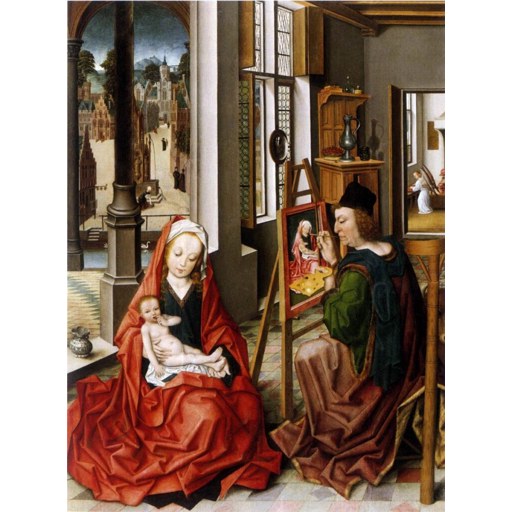
https://dailyartmagazine.com/saint-luke-the-ultimate-holy-painter
License: unknown
Hermes
Saint- Feast Day
- 28 August
- Gender
- male
- Church
- Catholic
Places
Roles & Family
Biography
Saint Hermes, commonly called Hermes of Rome, is an early Christian martyr whose public cult in the city of Rome is attested by the mid-fourth century. The Depositio martyrum in the Chronograph of 354 records that on 28 August the Roman Church commemorated him at the cemetery of Basilla on the Via Salaria Vetus, a burial ground later known as the Catacomb of Hermes. That notice is among the oldest liturgical documents of the Roman Church and shows that veneration was already attached to a known tomb well before any full-scale legendary biography was written. The later Roman Martyrology describes him as a man of substantial means who was imprisoned and then put to the sword, a summary that reflects medieval reading of his Acts rather than an independent contemporary record.
The narrative that later gathered around his name appears in the Passio of Pope Alexander I and related texts. There Hermes is presented as a prefect of Rome who, together with a sister named Theodora, was converted and baptized, then condemned by a judge called Aurelian and executed in the reign of the emperor Hadrian, a setting often placed around the year 120. Early modern hagiographers repeated this story, but critical scholarship has long treated the passio as a late and largely fictitious composition, written to supply an identity for a martyr whose real circumstances had been forgotten. Neither the urban prefecture nor a Hadrianic date can be confirmed from independent pagan or Christian sources of the second century, and no reliable evidence establishes his year of birth, birthplace, occupation, or family life.
Archaeology and the early medieval itineraries of the graves of the Roman martyrs give a firmer picture of the cult. A basilica was built over the tomb in the cemetery of Basilla, and pilgrims of the seventh and eighth centuries were directed to the resting place of Saint Hermes on the Via Salaria. In the ninth century Pope Sergius II translated relics from the decaying suburban cemeteries into the city; relics attributed to Hermes were among those moved and were later claimed by several churches in Rome and beyond. A notable medieval cult developed at Salzburg, which received relics and honored him in its local liturgy. Despite these translations, the original catacomb continued to bear his name, preserving the link between the martyr and the northern approaches to Rome.
Hermes was never Bishop of Rome and never held a patriarchal or catholicos see, nor is he associated with a religious order. Nothing historically secure is known of a marriage or of children. His feast has remained 28 August in the Roman Martyrology, though in the general calendar it has long stood in the shadow of Saint Augustine, kept on the same day. He did not acquire a wide set of specialized later medieval patronages. Other early Christian figures named Hermes or Hermas—including the person greeted by Paul in Romans 16:14 and, in Eastern lists, one of the Seventy—are distinct traditions and should not be merged with the Roman martyr of the Via Salaria. What can be said with confidence is that an early Roman Christian named Hermes was honored as a martyr at that tomb from at least the fourth century, that his cult was important enough to name a cemetery and a basilica, and that the elaborate biography circulating in the Middle Ages should be treated as legend rather than verified history.