Hermit Barsanuph is a saint of the Catholic Church. Hermit Barsanuph's feast day is celebrated on 6 February.
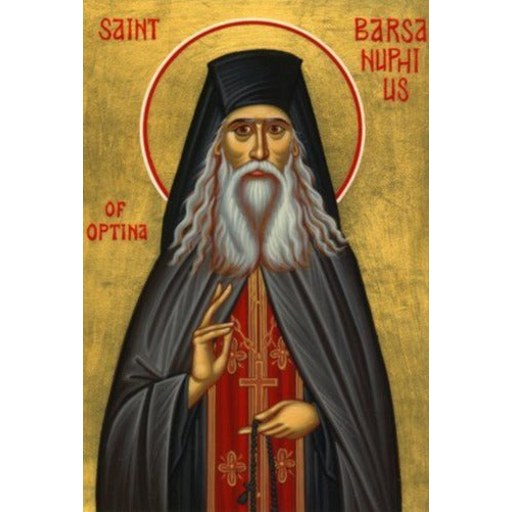
https://handmadeiconsgreece.myshopify.com/en-us/products/saint-barsanuphius
License: unknown
Hermit Barsanuph
Saint- Feast Day
- 6 February
- Gender
- male
- Church
- Catholic
Places
Roles & Family
Biography
Saint Barsanuphius, also called Barsanuph or Barsanuphius the Great, was a Christian hermit and spiritual director of the sixth century. He was of Egyptian origin and later lived as a recluse at the monastery of Abba Seridus (Serid) in the region of Gaza in Palestine. There he remained in strict enclosure, unseen by ordinary visitors, and was known among the monks as the Great Old Man. His fellow recluse, Saint John the Prophet (John of Gaza), occupied a neighboring cell and was called the Other Old Man. Communication with the community and with outside inquirers passed almost entirely through written questions and answers, at first conveyed by Abbot Seridus and later by other monks of the house.
The correspondence attributed to Barsanuphius and John runs to several hundred letters. It addresses prayer, obedience, humility, the discernment of thoughts, relations with those accused of heresy, and the ordinary trials of monastic and lay life. Internal evidence places the letters in the first half of the sixth century, during the reign of the Emperor Justinian I, and they reflect the Origenist disputes that troubled Palestinian monasteries in that period. The collection is one of the principal surviving witnesses to Gazan monasticism and to the Eastern Christian practice of spiritual fatherhood. Barsanuphius himself appears in the letters as a man of severe seclusion, practical counsel, and caution in doctrinal controversy.
No contemporary source records a birth year or an exact death year. He flourished in the early to mid-sixth century; later hagiographical notices place his death around the middle of that century, after the repose of John the Prophet. He held no episcopal, patriarchal, or papal office. He is presented throughout the tradition as a monk who chose the eremitical life, and there is no evidence that he married or had children. The precise site of his burial is not documented in early sources. Later Western notices of a Saint Barsanuphius whose relics were kept at Oria in Apulia are often treated as referring to a different figure, an Egyptian monk who became a bishop in Italy, and should not be assumed to identify the Gaza hermit without further proof.
Veneration of Barsanuphius is ancient in the Eastern Orthodox Church and is also found in the Catholic Church. His principal feast is kept on 6 February. Beyond his Egyptian birth, his long enclosure near Gaza, and the witness of the letters, little else can be verified about his early life or the circumstances of his death. The letters remain the basis for what can be known of his teaching: a sober emphasis on humility, cut-off of one’s own will, unceasing prayer, and discernment under an elder, offered to monks and to lay Christians alike in the Gazan desert tradition associated with earlier figures such as Hilarion.