Hermit Galgan is a saint of the Catholic Church (d. 1181). Hermit Galgan's feast day is celebrated on 3 December. Hermit Galgan is the patron saint of Chiusdino.
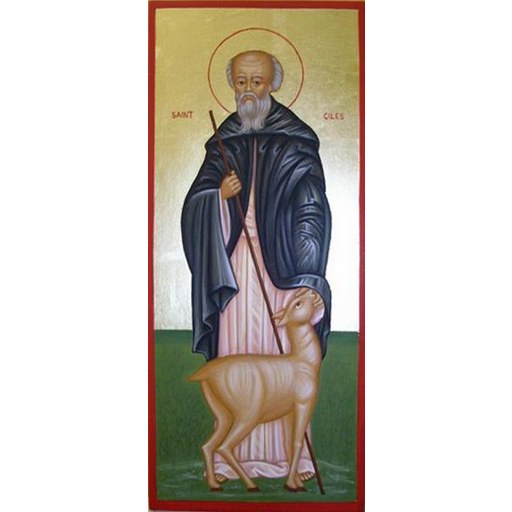
https://handmadeiconsgreece.myshopify.com/en-us/products/saint-giles-the-hermit
License: unknown
Hermit Galgan
Saint- Life Span
- d. 1181
- Feast Day
- 3 December
- Gender
- male
- Church
- Catholic
Places
Roles & Family
Patronage
Chiusdino
Canonization
Biography
Galgano Guidotti, known in Latin as Galganus and sometimes rendered in English as Galgan, was a Tuscan hermit of the twelfth century whose cult developed rapidly after his death. He is associated with the hill of Montesiepi in the territory of Chiusdino, in the region of Siena. Tradition places his birth in Chiusdino itself, to a family of the local nobility, in the middle of the twelfth century; a year often repeated in later summaries is not independently documented and should not be treated as certain. Surviving accounts of his early life derive from hagiographical texts connected with his canonization. They describe him as a knight who followed the violent and worldly customs of his class until a religious conversion, attributed in the legend to visions of the Archangel Michael, led him to renounce arms and withdraw from secular society.
After his conversion he settled as a hermit on Montesiepi. The central episode of his legend holds that he sought to erect a cross on the hill and, finding no suitable wood or being otherwise impeded, thrust his sword into a rock, where it remained embedded in the form of a cross. A round chapel, the Rotonda di Montesiepi, was later built over this site. A sword fixed in stone is still displayed there and has long been an object of devotion; it has also been examined in modern times as a physical artifact. Galgano spent his remaining years in eremitical solitude at that place. He did not belong in his lifetime to a canonical religious order; the great Cistercian house later associated with his name was founded after his death.
He died on 3 December 1181 at his hermitage. Veneration began at once among the people of the Sienese countryside. In 1185 Pope Lucius III canonized him, an unusually prompt papal confirmation of cult for the period and one of the earlier instances of formal papal canonization. Cistercian monks subsequently established a large abbey in the valley below the hermitage, the Abbey of San Galgano, which became one of the notable Cistercian houses of Tuscany. The abbey church is now a roofless ruin, while the twelfth-century rotunda on the hill remains standing and continues to attract pilgrims. Relics and the sword-shrine were the focus of the medieval cult; later centuries also saw disputes and translations of remains typical of a popular local saint.
Historical reconstruction of Galgano’s life depends almost entirely on the vitae produced for and after the canonization, together with the early growth of the shrine. Precise details of his family, the inner chronology of his conversion, and any events of his knighthood before the hermitage are not independently documented and should be treated with caution. What is secure is the existence of a hermit of this name whose tomb and sword-relic at Montesiepi became the focus of a recognized cult by the mid-1180s, and whose memory was thereafter maintained by the Cistercians and by the commune of Chiusdino, of which he is the patron. His feast is observed on 3 December.