Hermogenes is a saint of the Eastern Orthodox Church (1858 - 1918). Hermogenes's feast day is celebrated on 16 June.
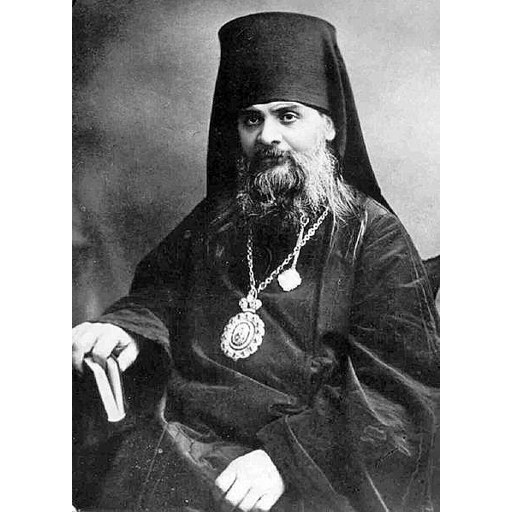
License: Public domain
Hermogenes
Saint- Life Span
- 1858 - 1918 (age 60)
- Feast Day
- 16 June
- Gender
- male
- Church
- Eastern Orthodox
Places
Relics & Where to Venerate
Location unknown
The bodily remains of Hermogenes are a first-class relic. Venerated at Tobolsk.
Roles & Family
Canonization
Biography
Hermogenes, in the world Georgy Yefremovich Dolganyov, was a Russian Orthodox bishop later glorified as a hieromartyr of the twentieth-century persecution of the Church in Russia. He was born on 25 April 1858 in the Kherson Governorate of the Russian Empire, the son of a parish priest. His father, Yefrem Dolganyov, had come from an Old Believer background before serving in the clergy of the established Orthodox Church. Georgy received both secular and theological training: after seminary studies he attended university courses and then completed the Saint Petersburg Theological Academy in the late 1880s. He was tonsured a monk with the name Hermogenes, ordained to the priesthood, and assigned to teaching and administrative work, including service at the Tiflis Theological Seminary in the Caucasus, where he was known for strict discipline and missionary seriousness.
In 1901 he was consecrated a bishop, first as vicar Bishop of Volsk in the Saratov diocese, and from 1903 as ruling Bishop of Saratov and Tsaritsyn on the Volga. His years in Saratov made him one of the best-known conservative hierarchs of the late imperial Church. He preached against drunkenness and revolutionary agitation, promoted parish schools and temperance work, and supported monarchist patriotic organizations such as the Union of the Russian People. He regarded liberal theology, secular entertainments in fast seasons, and political radicalism as dangers to Orthodox life. From about 1910 he became an outspoken opponent of Grigori Rasputin, whose influence at the imperial court he considered spiritually disastrous. Together with Hieromonk Iliodor he sought to force Rasputin to repent. The quarrel reached Tsar Nicholas II and the Holy Synod. In early 1912 Hermogenes was dismissed from the Saratov see, forbidden to reside in the capitals, and confined to monastic seclusion, first at the Zhirovitsky Monastery in the western provinces and later at the Nikolo-Ugreshsky Monastery near Moscow.
The February Revolution of 1917 ended his confinement. He took part in the All-Russian Local Council of 1917–1918, which restored the Moscow patriarchate, and was appointed Bishop of Tobolsk and Siberia. He arrived in western Siberia while the former emperor Nicholas II and his family were still held under guard in Tobolsk, and he showed pastoral concern for the prisoners so far as conditions allowed. After the Bolsheviks seized power he refused to accept Soviet decrees on church property, schools, and the subordination of ecclesiastical life to the new regime. He protested the persecution of clergy and the seizure of churches. In April 1918 the Soviet authorities in Tobolsk arrested him on charges of counter-revolutionary and monarchist activity.
In June 1918, as anti-Bolshevik forces and the Czechoslovak Legion advanced through Siberia, the local Cheka resolved to prevent the bishop’s liberation. On 29 June 1918 (16 June on the Julian calendar then used by the Russian Church), Hermogenes was taken to the Tura River. Contemporary and later church accounts state that a stone was fastened to his body and that he was thrown into the water and drowned; the priest Peter Karelin was killed in the same episode. The bishop’s body was later recovered downstream and buried. The Russian Orthodox Church Outside Russia glorified him as a new martyr in 1981. In August 2000 the Jubilee Bishops’ Council of the Moscow Patriarchate numbered him among the New Martyrs and Confessors of Russia. He is commemorated on 16 June, the date of his death on the church calendar, and with the synaxis of Russia’s twentieth-century martyrs.