Hesychius of Durostorum is a saint of the Catholic Church. Hesychius of Durostorum's feast day is celebrated on 15 June.
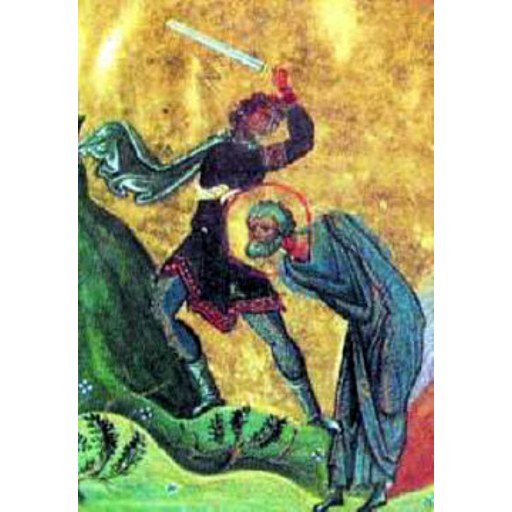
Authors of Menologion of Basil II (circa 985 AC, Constantinople), Byzantine manuscript illuminators[4]: Pantoleon with Georgios, Michael the Younger, Michael of Blachernae, Symeon, Symeon of Blachernae, Menas, and Nestor (Online on Vatican site)
License: Public domain
Hesychius of Durostorum
Saint- Feast Day
- 15 June
- Gender
- male
- Church
- Catholic
Places
Roles & Family
Biography
Hesychius of Durostorum (also called Hesychius of Dorostolum or Hesychios) was an early Christian martyr linked to the Roman legionary city of Durostorum on the lower Danube, in the province of Moesia Inferior, corresponding to present-day Silistra in Bulgaria. The city was the base of Legio XI Claudia and an important military centre on the empire’s northern frontier. Almost nothing can be established about his birth, parentage, upbringing, or career before the events that led to his death. The ancient notices that mention him identify him only as a soldier (miles) serving at that fortress.
In the opening years of the fourth century the emperors Diocletian and Maximian launched the last systematic empire-wide persecution of Christians. Military personnel were among those required to demonstrate loyalty by sacrificing to the traditional gods of Rome. Hesychius refused and confessed himself a Christian. The brief entry in the Roman Martyrology records that he was executed by drowning: a stone was fastened to his neck and he was cast into the river, understood to be the Danube. Eastern synaxaria preserve the same essential outline. No extended narrative of his trial or imprisonment has survived in a form that modern historians treat as independently reliable, so the precise year of his death cannot be fixed, though it belongs to the period of the Great Persecution.
Durostorum is otherwise known for a cluster of soldier-martyrs from the same persecution. The Latin Passion of Julius the Veteran, set at Durostorum and conventionally placed in 304, describes the trial of a Christian veteran by a prefect and his subsequent beheading. Other local martyrs include Dasius, whose Greek acts recount a refusal to take part in a pagan festival. Hesychius belongs to this same military-Christian milieu on the Danube frontier, yet the sources for his own death remain limited to short martyrological notices. Consequently later attempts to reconstruct a fuller biography rest on conjecture rather than evidence.
He has been venerated as a saint in both the Latin and Greek churches. His name appears in the Roman Martyrology on 15 June and in corresponding Eastern calendars. No ancient church or identifiable tomb at Silistra can be securely linked to him, and no relics of documented pedigree are known. Later medieval or early-modern elaborations of his legend, if they existed, have not entered the standard critical hagiographical collections. The historical Hesychius therefore remains an obscure figure whose memory is preserved almost exclusively by the liturgical commemoration of a soldier who chose drowning rather than apostasy.