Hesychius is a saint of the Catholic Church. Hesychius's feast day is celebrated on March 28.
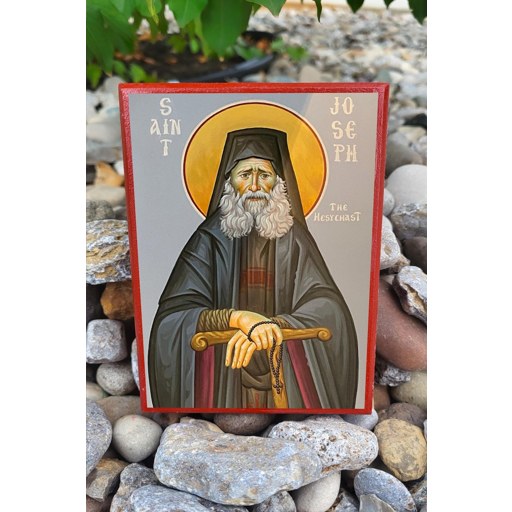
https://www.etsy.com/listing/4358196820/saint-joseph-the-hesychast-orthodox-icon
License: unknown
Hesychius
Saint- Feast Day
- March 28
- Gender
- male
- Church
- Catholic
Places
Roles & Family
Biography
Hesychius of Jerusalem was a Christian priest, monk, preacher, and biblical commentator active in Jerusalem in the first half of the fifth century. Almost nothing is known of his family, childhood, or place of origin; neither a year of birth nor a native city is preserved in the ancient sources. He enters history as a monk who was ordained to the priesthood in the Church of Jerusalem and who gained a reputation there as a preacher and as an interpreter of Scripture. The sixth-century hagiographer Cyril of Scythopolis, writing in the Judean desert tradition, later described him as a theologian and a luminary of the church, which indicates the high regard in which he was held in Palestinian monastic and clerical circles within a century of his death. Jerusalem in his lifetime was a major pilgrimage center, adorned by Constantinian and later imperial churches, and was also a stage for the Christological and liturgical disputes that marked the eastern empire after the First Council of Ephesus.
His surviving literary legacy, written in Greek, consists chiefly of biblical exegesis and homilies. Commentaries or scholia associated with his name cover Leviticus, the Psalms, Isaiah, the Twelve Prophets, and other books of Scripture; many of these texts are preserved only in fragmentary form or as excerpts in medieval catenae compiled for later Byzantine readers. He also composed festal and moral homilies, including sermons connected with the Jerusalem liturgical calendar, and is reported to have written a church history that has not survived. In method he stands close to the Alexandrian tradition associated with Origen and Cyril of Alexandria, combining attention to the wording of the biblical text with spiritual, typological, and moral reading. He opposed Nestorian Christology and is generally counted among the supporters of the Alexandrian emphasis on the unity of Christ. Because more than one late-antique Christian writer bore the name Hesychius—including a lexicographer of Alexandria and a later monk of Sinai—the attribution of particular works is often uncertain, and modern scholars continue to sort authentic material from later or misattributed pieces.
The year and precise circumstances of his death are not recorded. He is generally assigned to the mid-fifth century. Older handbooks sometimes placed his death about 433, while other assessments, based on possible allusions to later Christological debates, have suggested that he lived into the period of the Council of Chalcedon in 451 or shortly thereafter; none of these dates is secure, and a precise year of death cannot be verified. He is believed to have ended his life in Jerusalem, the city of his ministry. He did not hold episcopal, patriarchal, or papal office; contemporary and near-contemporary notices consistently describe him as a presbyter. Consistent with his monastic formation and priestly state in a celibate monastic milieu, no ancient source records a wife or children.
Liturgical commemoration of Hesychius as a saint is ancient and belongs to the era before the later formal papal processes of beatification and canonization; no individual canonizing authority can be named. The Roman Martyrology lists him on 28 March as a priest of Jerusalem, and Eastern Christian calendars likewise keep his memory on that date. No well-documented patronages of cities, trades, illnesses, or special causes are attached to him in the standard martyrologies and directories of saints. His historical importance lies in his witness to the exegetical, homiletic, and theological culture of fifth-century Jerusalem rather than in a richly documented personal life. What can be said of him with confidence remains limited, and silence in the sources should not be filled with conjecture.