Hilarion of Kyiv is a saint of the Catholic Church. Hilarion of Kyiv's feast day is celebrated on 21 October.
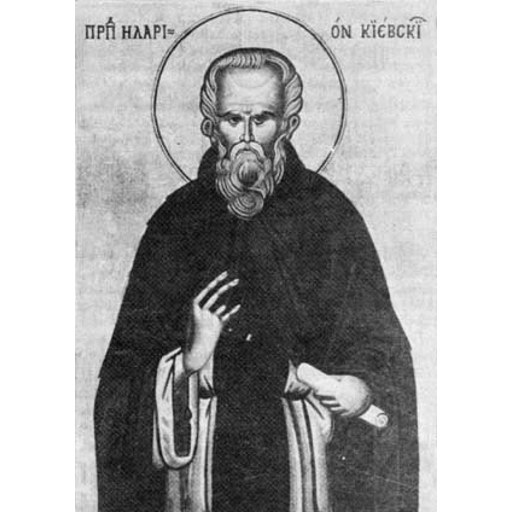
Unknown authorUnknown author
License: Public domain
Hilarion of Kyiv
Saint- Feast Day
- 21 October
- Gender
- male
- Church
- Catholic
Places
Roles & Family
Biography
Hilarion of Kiev, also known as Ilarion, was an eleventh-century cleric of Kievan Rus' who became the first Metropolitan of Kiev of East Slavic origin. No reliable source records the year or precise place of his birth. The Primary Chronicle presents him as a Rus' priest serving at the Church of the Holy Apostles in the princely village of Berestovo, near Kiev, and as a man distinguished for book learning and piety. Before his elevation he lived as a hermit, having dug a small cave in a hill above the Dnieper in which he recited the hours. That cave later belonged to the complex of the Kiev Pechersk Lavra, the Monastery of the Caves, though the organized monastic community there is more closely associated with Saint Anthony of Kiev.
In 1051 Grand Prince Yaroslav the Wise convened a synod of bishops of the Rus' land, which elected and consecrated Hilarion as Metropolitan of Kiev and All Rus'. Earlier metropolitans had been Greeks appointed by the Patriarch of Constantinople. The choice of a local candidate, made without a prior patriarchal nomination, was unusual and has been interpreted as an expression of the political and ecclesiastical confidence of Yaroslav's court. A Confession of Faith is associated with his consecration. He occupied the Kievan see during the last years of Yaroslav's reign. After the grand prince's death in 1054 the see again received Greek metropolitans from Constantinople, and Hilarion vanishes from the chronicle. Neither the date nor the place of his death is known from contemporary testimony, and no early source identifies his grave.
Hilarion's principal surviving work is the Sermon on Law and Grace, composed in the mid-eleventh century, probably before or around the time of his metropolitanate. The oration contrasts the Law given through Moses with the Grace and Truth that came through Jesus Christ, then turns to the baptism of the Rus' land under Prince Vladimir, whom it praises as a new Constantine. The text asserts that the newly converted people share fully in Christian dignity alongside older Christian nations. A prayer and the confession of faith are also attributed to him. These writings rank among the earliest original theological and rhetorical compositions in the East Slavic tradition and were transmitted in later medieval manuscript collections.
The Eastern Orthodox Church venerates Hilarion as a saint and commemorates him on 21 October. He is not known to have married or to have had children; the sources depict him as an ascetic priest who lived in a cave and then as a bishop, an office that in the Byzantine canonical tradition required monastic celibacy. Many aspects of his biography remain obscure. Later hagiographical tradition expanded his memory within the Kievan church, but the securely attested facts are few: his priesthood at Berestovo, his cave hermitage, his appointment in 1051, his authorship of the Sermon on Law and Grace, and his subsequent disappearance from the written record.