Hilda is a saint of the Catholic Church (614 - 680). Hilda's feast day is celebrated on 17 November. Hilda is the patron saint of Whitby;learning;education;poetry;culture.
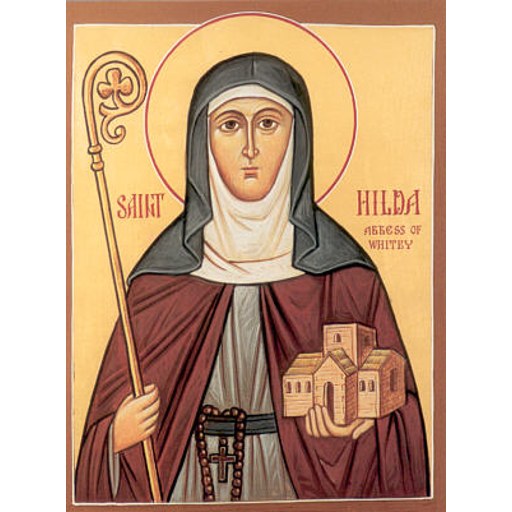
Unknown authorUnknown author
License: Public domain
Hilda
Saint- Life Span
- 614 - 680 (age 66)
- Feast Day
- 17 November
- Gender
- female
- Church
- Catholic
Places
Roles & Family
Religious Information
Patronage
Whitby;learning;education;poetry;culture
Biography
Hilda of Whitby (also called Hild) was born in 614 into the royal kindred of Deira in what is now northern England. She was the daughter of Hereric, a nephew of King Edwin of Northumbria, and of Breguswith. While she was still an infant her father was poisoned in exile at the court of Cerdic, king of the British kingdom of Elmet. Hilda and her sister Hereswith were thereafter brought up at Edwin’s court. In 627, at about the age of thirteen, she received baptism at York together with the king and his household, at the hands of the Roman missionary Paulinus. Bede, the principal narrative source for her life, records that she spent the first thirty-three years in the secular habit before turning to the monastic life.
Around 647 she intended to join Hereswith, who had already entered the Frankish monastery of Chelles in Gaul. Aidan, bishop of Lindisfarne, instead recalled her to Northumbria. She first lived for about a year with a few companions on the north bank of the River Wear, then succeeded Heiu as abbess of the monastery at Hartlepool (Heruteu). In 657 she established, or was entrusted with, a new double monastery at Streaneshalch, later identified with Whitby on the Yorkshire coast. Men and women lived there in separate dwellings under her single authority, a pattern familiar in Irish and early Anglo-Saxon monasticism. The house became a centre of study and of the training of clergy.
In 664 King Oswiu of Northumbria held at her monastery the synod that decided the Northumbrian church would follow Roman rather than Celtic customs for the dating of Easter and related observances. Hilda had been formed in the Lindisfarne tradition associated with Aidan, yet she accepted the king’s judgment. Bede presents her as a counsellor to whom kings and ordinary people alike resorted, and as a superior who required her community to divide its time between the Scriptures and works of justice. From Whitby came at least five men later consecrated bishops: Bosa of York, Ætla of Dorchester, Oftfor of Worcester, John of Beverley, and Wilfrid. The cowherd Cædmon, according to Bede, received there the gift of religious song in the vernacular; Hilda recognized his vocation, received him into the community, and had him instructed so that he might turn sacred narrative into English verse, making him the earliest named English poet.
For the last six years of her life she suffered a recurrent fever but continued to govern Whitby and a daughter house at Hackness. She died on 17 November 680, aged sixty-six, and was buried at her monastery. Bede relates that a nun named Begu at Hackness saw, at the hour of Hilda’s death, a vision of the abbess’s soul carried to heaven by angels. Veneration began in the generations immediately following; she is commemorated on 17 November in the Roman Martyrology and in many Anglican calendars (sometimes observed on 19 November where 17 November is occupied by another feast). After the ninth-century destruction of the original house, later medieval communities claimed relics, but her historical and cultic centre remains Whitby. She is remembered as a leading figure of seventh-century Northumbrian Christianity, a founder of monastic life for women and men, and a patron of learning, education, poetry, and the town of Whitby.