Hildegrim of Châlons is a saint of the Catholic Church (d. 827). Hildegrim of Châlons's feast day is celebrated on 19 June.
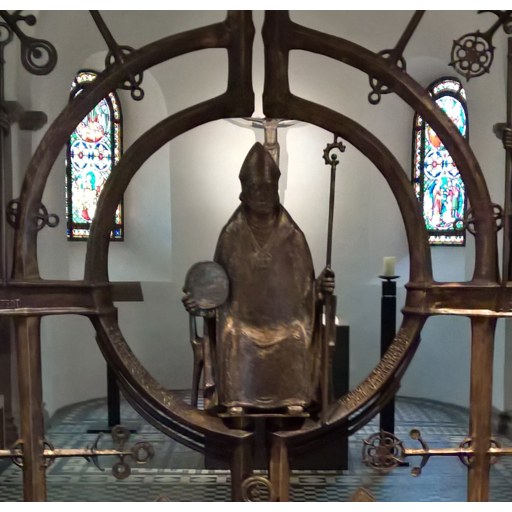
Ab2505 (cropped by Rabanus Flavus)
License: CC BY-SA 4.0
Hildegrim of Châlons
Saint- Life Span
- d. 827
- Feast Day
- 19 June
- Gender
- male
- Church
- Catholic
Places
Relics & Where to Venerate
Location unknown
The bodily remains of Hildegrim of Châlons are a first-class relic. Venerated at Werden Abbey.
Roles & Family
Religious Information
Biography
Hildegrim of Châlons, also known as Hildegrimus and sometimes as Hildegrim of Werden, was a Frisian churchman of the late eighth and early ninth centuries who served as a missionary, as bishop of Châlons-sur-Marne, and as abbot of Werden. He belonged to a noble Christian family in Frisia. His father was Thiadgrim and his mother Liafburg, and he was the younger brother of Saint Ludger (Liudger), the missionary who became first bishop of Münster and founder of Werden Abbey. The family formed part of the Frisian aristocracy that had accepted Christianity in the generations after Willibrord. No contemporary source records Hildegrim’s year or place of birth. Later tradition places him in the mid-eighth century in Frisia, in the same milieu in which Ludger was born and raised near Utrecht. He is generally assumed to have received a clerical education in the school associated with Gregory of Utrecht, as his brother did, and he may have shared in further studies, but those details are not independently attested for Hildegrim himself. What is secure is his close association with Ludger’s mission and with the monastic foundation at Werden.
Hildegrim’s public career belongs to the Saxon and Frisian missions of the Carolingian age. He worked alongside Ludger in preaching and in organizing churches among the Saxons after Charlemagne’s wars had brought that people under Frankish rule. In the first years of the ninth century he was named bishop of Châlons-sur-Marne (Latin Catalaunum, later Châlons-en-Champagne), an ancient see in Champagne. Episcopal catalogues include him among the bishops of that church in the early ninth century and assign him a tenure lasting until his death in 827. The appointment of a northern missionary to an established Gallic diocese illustrates Carolingian practice of placing trusted men in older sees while they continued to support work on the frontier. Hildegrim remained associated with Châlons even after he took on monastic office in Saxony, a combination of charges that the Carolingian church permitted.
When Ludger died in 809, Hildegrim succeeded him as abbot of Werden on the Ruhr and of the related house at Helmstedt. Werden had been founded by Ludger as a Benedictine monastery and as a centre for the Saxon mission; it also became the burial place of the founder. As second abbot, Hildegrim was responsible for the community’s observance, for the cult of his brother, and for the continued Christianization of the surrounding Saxon population. He thus stood at the junction of three roles: diocesan bishop in Champagne, monastic superior on the Ruhr, and missionary in Saxony. The sources do not preserve a detailed administrative record of his abbacy, but the continuity of Werden and Helmstedt after Ludger’s death is itself evidence that Hildegrim maintained the foundations his brother had laid. Much of what is known about him is drawn from the hagiographical orbit of Ludger, especially the Vita Liudgeri associated with the family, from necrologies, and from episcopal lists rather than from a separate contemporary life of Hildegrim.
Hildegrim died on 19 June 827 and was buried at Werden Abbey, near Ludger. He was honoured as a saint in the monastic tradition of Werden and in the diocese of Châlons. His feast day is 19 June. No papal canonization in the later medieval sense is recorded; his cult belongs to the older pattern of local episcopal and monastic veneration. A dedicated medieval vita of Hildegrim does not survive, and many personal details remain unknown. He remains an important if poorly documented figure in the second generation of the Saxon mission and in the early history of Werden.