Hugh Canefro is a saint of the Catholic Church (1148 - 1233). Hugh Canefro's feast day is celebrated on 8 October.
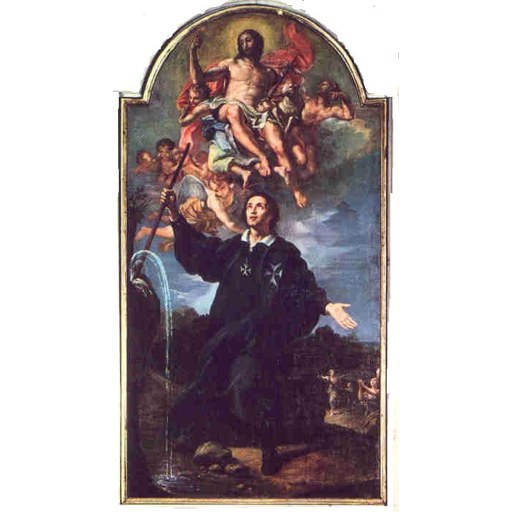
Giovanni Andrea de Ferrari
License: Public domain
Hugh Canefro
Saint- Life Span
- 1148 - 1233 (age 85)
- Feast Day
- 8 October
- Gender
- male
- Church
- Catholic
Places
Roles & Family
Religious Information
Biography
Hugh Canefri (Italian: Ugo Canefri or Ugo Canefro; also called Hugh of Genoa) was a Hospitaller knight of the late twelfth and early thirteenth centuries, venerated as a saint in the Catholic Church. Traditional accounts place his birth in 1148 at Alessandria in Piedmont, in northwestern Italy, and describe him as belonging to a noble family. The commune of Alessandria itself was formally founded only in 1168, by a league of Lombard towns, from older settlements in the same district; the birthplace given in later lives may therefore reflect that district or later civic tradition rather than a documented origin inside the later walled city. Almost nothing of his childhood or youth is known from contemporary records. The outline of his career depends largely on Genoese and Hospitaller tradition and on hagiographical texts written after his death.
As a young man he entered the Order of the Hospital of Saint John of Jerusalem, the military-religious order founded in the Holy Land to care for sick pilgrims and to defend crusader territories. He was assigned to the order’s house in Genoa, the commandery of San Giovanni di Pré (the Commenda di Pré), a large complex of church, hospital, hospice, and stores on the city’s western waterfront. Genoa was then a leading maritime republic and a principal western port for traffic with the Levant; the Pré commandery received pilgrims, stored supplies for the East, and maintained a hospital for the poor and the sick of the city. Canefri served there for many years, according to tradition as treasurer or administrator of the house’s goods. Professed Hospitaller knights took vows of poverty, chastity, and obedience, and he is remembered for personal austerity and for applying the order’s resources to the needy.
Later devotion credited him with exceptional charity during famine and epidemic in Genoa, and with miracles of provision for the poor. Such stories are typical of medieval hospitaler saints and cannot be verified in detail from independent chronicles, but they explain the strength of his local cult. He died in Genoa on 8 October 1233, at an advanced age if the traditional birth year is accepted, and was buried in the church of the commandery, San Giovanni di Pré. His tomb became a centre of prayer. His feast is observed on 8 October.
Canefri was not the subject of a formal papal canonization of the kind later required by the Holy See. His status as a saint rests on immemorial cult in Genoa and Alessandria and within the Hospitaller tradition, continued today by the Sovereign Military Order of Malta. Outside those circles he remains a relatively obscure figure: no substantial contemporary biography survives, and modern historical knowledge of him is limited to his affiliation with the order, his long service at the Genoese commandery, the traditional dates of birth and death, his burial at San Giovanni di Pré, and the existence of a medieval cult at that church.