Hugh of Lincoln is a saint of the Catholic Church (d. 1200). Hugh of Lincoln's feast day is celebrated on 17 November. Hugh of Lincoln is the patron saint of Lincoln;swans;sick children;the sick.
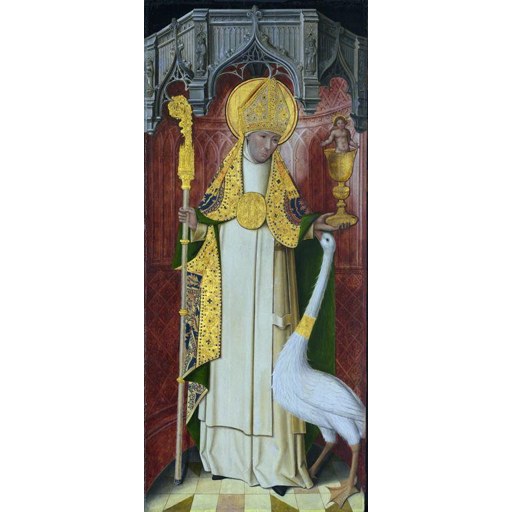
Unknown authorUnknown author
License: Public domain
Hugh of Lincoln
Saint- Life Span
- d. 1200
- Feast Day
- 17 November
- Gender
- male
- Church
- Catholic
Places
Relics & Where to Venerate
Location unknown
The bodily remains of Hugh of Lincoln are a first-class relic. Venerated at Lincoln.
Roles & Family
Religious Information
Patronage
Lincoln;swans;sick children;the sick
Canonization
Biography
Hugh of Lincoln, known also as Hugh of Avalon, was born at the castle of Avalon near Pontcharra in the Dauphiné, in a region then belonging to the Kingdom of Burgundy within the Holy Roman Empire and now in southeastern France. His birth fell in the second quarter of the twelfth century; later writers often give a date around 1135 or 1140, but no contemporary record fixes the year. He was a son of William, lord of Avalon. After the death of Hugh’s mother, William retired from secular life and entered the Augustinian priory of Villarbenoît, taking his young son to be raised and educated among the canons. Hugh joined that community, received formation in the religious life, and was ordained to the diaconate. Already noted for seriousness and self-discipline, he sought a harsher solitude than the canons offered and obtained permission to enter the Grande Chartreuse, the founding house of the Carthusian order in the mountains above Grenoble.
At the Grande Chartreuse Hugh spent roughly ten years. Carthusian life combined eremitical cells with limited community worship, and Hugh’s competence in practical affairs led to his appointment as procurator, the monk charged with the monastery’s external business. In that office he dealt with visitors and benefactors while keeping the Carthusian rule. In the late 1170s Henry II of England founded a Carthusian house at Witham in Somerset, intended in part as satisfaction after the killing of Archbishop Thomas Becket. The English foundation faltered through lack of leadership and uncertain endowments. The Grande Chartreuse sent Hugh as prior. He reached England about 1179 or 1180, insisted that the king complete the grant of lands, and gradually formed a regular Carthusian community at Witham. Henry II, though often at odds with churchmen, developed a regard for Hugh’s blunt honesty and refused to take lasting offence at his rebukes.
In 1186 the cathedral chapter of Lincoln chose Hugh as bishop. Lincoln was then the largest diocese in England, impoverished and disorganized after a long vacancy and the recent earthquake that had wrecked much of the Romanesque cathedral in 1185. Hugh would not accept until the Carthusian authorities consented and until he believed the election free of royal dictation. He was consecrated in 1186 and thereafter divided his time between episcopal duty and such monastic observance as a bishop could keep. He began the rebuilding of Lincoln Cathedral in the new Gothic manner; the work associated with his years, including the choir, helped make Lincoln one of the great churches of medieval England. He held synods, visited his diocese, and tried to reform clergy and religious houses. He retained a Carthusian simplicity of life and was remembered for washing the feet of lepers and for personal care of the sick and the poor.
Hugh’s episcopate was marked by repeated collisions with the Angevin kings. He resisted forest officials and other royal agents who encroached on church rights, objected to heavy taxation of the clergy, and on occasion refused demands he thought unjust, whether from Henry II, Richard I, or John. He also acted to protect Jews in Lincoln and elsewhere when mobs threatened them, at a period when anti-Jewish violence was spreading in England. Contemporaries described him as fearless in the presence of the powerful and gentle toward the weak. A well-known story, already current in the generation after his death, concerned a swan at his manor of Stow that attached itself to the bishop and would not suffer others to come near him; the swan became a later emblem of the saint.
In 1200, after diplomatic service in France on behalf of King John, Hugh returned to England in failing health. He died at his residence in London on 16 November 1200. His body was taken north and buried in Lincoln Cathedral, where a shrine grew up and attracted pilgrims until the sixteenth-century Reformation destroyed it. Pope Honorius III canonized him in 1220, making Hugh the first Carthusian to be formally declared a saint. The principal medieval biography is the life written by Adam of Eynsham, Hugh’s chaplain, which remains the chief source for his career and character. His feast is observed on 16 November in the Roman calendar and on 17 November in the Church of England. He is venerated as a patron of Lincoln, of the sick and of sick children, and, by association with the Stow swan, of swans.