Hugh of Rouen is a saint of the Catholic Church (d. 730). Hugh of Rouen's feast day is celebrated on 9 April.
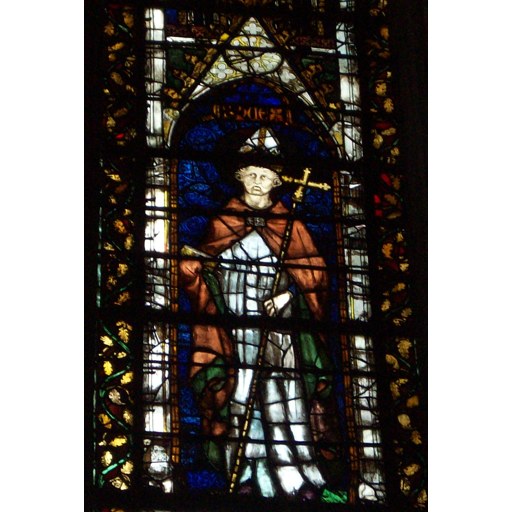
Giogo
License: CC BY-SA 3.0
Hugh of Rouen
Saint- Life Span
- d. 730
- Feast Day
- 9 April
- Gender
- male
- Church
- Catholic
Places
Relics & Where to Venerate
Location unknown
The bodily remains of Hugh of Rouen are a first-class relic. Venerated at Royal Saint-Peter's abbey of Jumièges.
Roles & Family
Religious Information
Biography
Hugh of Rouen, sometimes called Hugh of Champagne, was a Frankish churchman of the early eighth century and a member of the Pippinid family that dominated the politics of the Frankish kingdoms. He was the son of Drogo, Duke of Champagne, and therefore a grandson of Pepin of Herstal, mayor of the palace, and a nephew of Charles Martel. His brothers included other Pippinid nobles, among them Arnulf. Almost nothing is recorded of his childhood or education; even his year of birth is unknown, though he must have been born in the later seventh century in the Frankish realms, most likely in Austrasia or Champagne. The principal narrative sources that mention him are later monastic gesta, especially those of Fontenelle, and they present him as an aristocrat who entered the church and received a remarkable accumulation of offices.
In the second decade of the eighth century Hugh obtained the abbacies of Jumièges and of Fontenelle (Saint-Wandrille), two of the leading monasteries of the lower Seine in Neustria. He is also recorded as bishop of Paris and of Bayeux and, from 722, as archbishop of Rouen, the metropolitan see of the province. Holding several bishoprics and abbeys at once was not unusual among Frankish magnates of this generation; such pluralism bound church property and episcopal authority to the Pippinid kindred at a time when Charles Martel was consolidating power. Contemporary evidence for Hugh’s personal government of these churches is thin. Later Fontenelle tradition credits him with benefactions to the abbey and with an interest in its literary work, including the circle that produced the Vita Ansberti. As archbishop of Rouen he stood at the head of the Neustrian hierarchy, but no synodal acts or letters of his survive.
Hugh died in 730, the date traditionally given as 8 April, and was buried at Jumièges Abbey. A liturgical cult followed at the Norman monasteries associated with him. In the medieval calendars of the region he was commemorated as a saint, and the Catholic Church keeps his feast on 9 April. He was never the subject of a formal papal canonization, which did not yet exist in his era; his sanctity rests on local veneration and later martyrological entries. Modern historians treat him primarily as an example of Pippinid control of the Frankish church rather than as a figure whose inner life or pastoral program can be reconstructed in detail. The scarcity of eighth-century documentation means that many aspects of his career—his exact sequence of appointments, the degree to which he resided in each see, and his relations with Charles Martel—remain uncertain.
Beyond the offices he held and his place in the Pippinid genealogy, little verifiable information survives. No writings securely attributed to him are extant, no contemporary portrait of his character exists, and no specific miracles or pastoral initiatives are firmly dated to his lifetime in independent sources. His importance in later memory is thus largely institutional: he links the ducal house of Champagne to the great abbeys of the Seine and to the archiepiscopal see of Rouen on the eve of the Carolingian ascendancy. Later medieval writers of Fontenelle and Jumièges preserved his name among their abbatial lists and among the saints of Neustria, which is the basis of his continuing, if modest, cult.