Hyacinth is a saint of the Catholic Church (1185 - 1257). Hyacinth's feast day is celebrated on 17 August. Hyacinth is the patron saint of Poland;Lithuania;Kraków;people in danger of drowning.
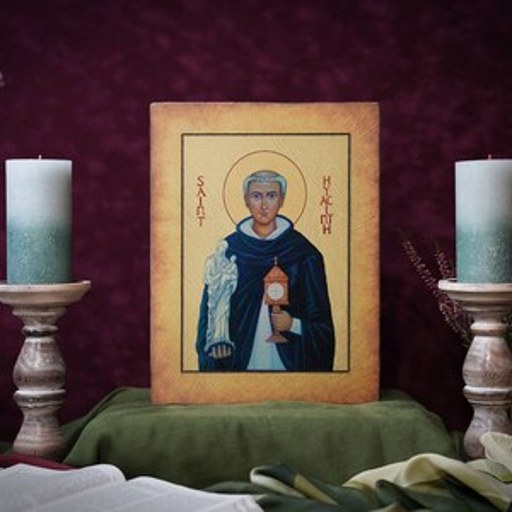
https://www.etsy.com/market/st_hyacinth_icon
License: unknown
Hyacinth
Saint- Life Span
- 1185 - 1257 (age 72)
- Feast Day
- 17 August
- Gender
- male
- Church
- Catholic
Places
Roles & Family
Religious Information
Patronage
Poland;Lithuania;Kraków;people in danger of drowning
Canonization
Biography
Saint Hyacinth, known in Polish as Jacek Odrowąż, was a thirteenth-century Dominican friar and missionary later styled the Apostle of the North. He was born about 1185 into the noble Odrowąż family at Kamień Śląski in Silesia, then under the Polish Piasts. After studies that tradition places at Kraków, Prague, and Bologna or Paris, he was ordained and became a canon of the cathedral chapter of Kraków. Around 1217–1221 he traveled to Rome in the household of his kinsman Ivo Odrowąż, bishop of Kraków. There he met Saint Dominic and, with companions including Blessed Ceslaus Odrowąż, received the habit of the Order of Preachers from Dominic himself, becoming one of the first Poles to enter the new order.
On his return he established the Dominican convent of the Holy Trinity at Kraków in 1222, which became the mother house of Dominican life in Poland. From that base he and his brethren preached across Lesser Poland and Silesia and toward the Baltic. Near-contemporary evidence supports this Polish and frontier expansion; later medieval lives greatly enlarged his itinerary, crediting him with personal missions through Prussia, Pomerania, Lithuania, and Ruthenia, and even with work at Kiev. The best-known later story holds that during a Mongol attack on Kiev he carried both the Blessed Sacrament and a heavy statue of the Virgin Mary from a threatened church and crossed a river unharmed. That episode, which later underpinned his patronage of people in danger of drowning, is treated by historians as hagiography rather than as a documented thirteenth-century event.
Hyacinth spent his final years at the Kraków priory and died there on 15 August 1257, the feast of the Assumption. He was buried in the Dominican church of the Holy Trinity in Kraków, where his tomb remains a place of pilgrimage. Popular veneration among Poles and Dominicans long preceded formal recognition by Rome. Pope Clement VIII canonized him on 17 April 1594. Because 15 August is occupied by the Assumption, his feast is kept on 17 August. In art he usually appears as a Dominican holding a monstrance and a Marian statue, recalling the Kiev legend.
Devotion to him has been especially strong in Poland and Lithuania, and he is invoked as a patron of Poland, of Kraków, and of those in danger of drowning. His cult traveled with the Order of Preachers elsewhere in Europe and to the Americas. Many of the more distant journeys and miracles attached to his name belong to later legend rather than to the thirteenth-century record, but the historical Hyacinth remains central as a founder of Dominican life in medieval Poland and as a figure around whom Polish Catholic and missionary memory later coalesced.