Hyacinth of Poland is a saint of the Catholic Church (d. 1257). Hyacinth of Poland's feast day is celebrated on 17 August. Hyacinth of Poland is the patron saint of Poland;Lithuania;those in danger of drowning.
Neithan90
License: CC0
Hyacinth of Poland
Saint- Life Span
- d. 1257
- Feast Day
- 17 August
- Gender
- male
- Church
- Catholic
Places


Relics & Where to Venerate
Location unknown
The bodily remains of Hyacinth of Poland are a first-class relic. Venerated at Basilica of the Holy Trinity, Kraków.
Roles & Family
Religious Information
Patronage
Poland;Lithuania;those in danger of drowning
Canonization
Biography
Hyacinth of Poland, known in Polish as Jacek Odrowąż, was a Dominican priest and missionary of the thirteenth century whose cult became central to the religious life of medieval and early modern Poland. He was born into the noble Odrowąż family in Silesia, with later tradition identifying his birthplace as Kamień Śląski, in the closing decades of the twelfth century. After an education that included studies in Kraków and at universities such as Prague and Bologna, he was ordained and became a canon of the cathedral chapter of Kraków. In the early 1220s he traveled to Rome in the company of his uncle Ivo Odrowąż, then bishop of Kraków. There he met Dominic of Caleruega, founder of the Order of Preachers. Together with his relative Ceslaus and other companions from the Polish lands, Hyacinth received the Dominican habit from Dominic himself, an event placed by the sources near the end of Dominic’s life, around 1220 or 1221.
Upon returning to Poland, Hyacinth took a leading part in planting the Dominican order north of the Alps. The first Polish priory was established at the church of the Holy Trinity in Kraków around 1222, and further houses followed in other towns of the Piast realm, including Sandomierz. From these convents he and his brethren conducted preaching missions among Christian populations and among still-pagan groups on the Prussian and Baltic frontiers. Traditional lives also credit him with journeys into Ruthenia, including a stay at Kiev, and with work in Pomerania. Later medieval and early modern hagiographers greatly enlarged this itinerary, sending him as far as Scandinavia, the Black Sea steppes, and even Inner Asia; critical historians regard those distant travels as legendary accretions and confine the historically plausible activity to Poland and its neighboring regions in the second quarter of the thirteenth century.
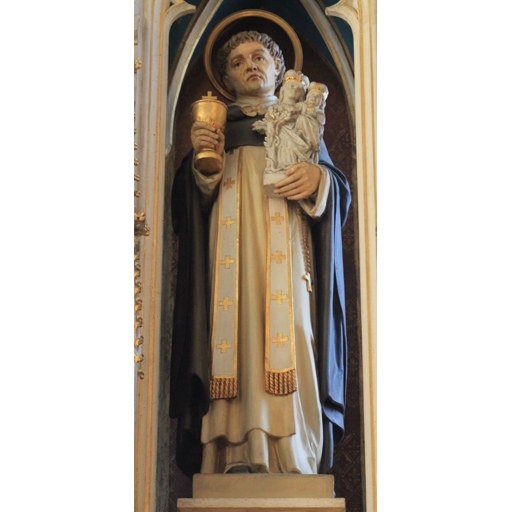
Miracle stories accumulated around his memory. The best-known legend relates that, during a raid on Kraków—often identified with the Mongol invasion of 1241 or a later Tatar attack—Hyacinth rescued the Blessed Sacrament from a church that was about to be destroyed. As he left, a statue of the Blessed Virgin is said to have addressed him, asking not to be abandoned; he then carried both the ciborium and the heavy image to safety across the Vistula River. Other wonders of healing, of calming storms, and of converting pagans were recorded in the later legendaries. He spent his final years at the Kraków priory and died there on 15 August 1257, the feast of the Assumption. He was buried in the church of the Holy Trinity, which remains the site of his tomb and shrine.
Veneration of Hyacinth spread rapidly in Poland and was strong also in Lithuania, of which he became a patron despite the fact that the grand duchy’s official conversion came only in the late fourteenth century. His cause was advanced in the sixteenth century, and Pope Clement VIII canonized him on 17 April 1594. In the General Roman Calendar his feast is observed on 17 August. He is invoked as a patron of Poland and of Lithuania and of people in danger of drowning, and he is sometimes styled the Apostle of the North. His relics continue to be honored in the Dominican basilica in Kraków, and he remains one of the most widely commemorated saints of the Polish Dominican province.