Ignatius is a saint of the Catholic Church (1491 - 1556). Ignatius's feast day is celebrated on 31 July. Ignatius is the patron saint of Society of Jesus;soldiers;spiritual exercises;spiritual retreats;Basque Country;Gipuzkoa.
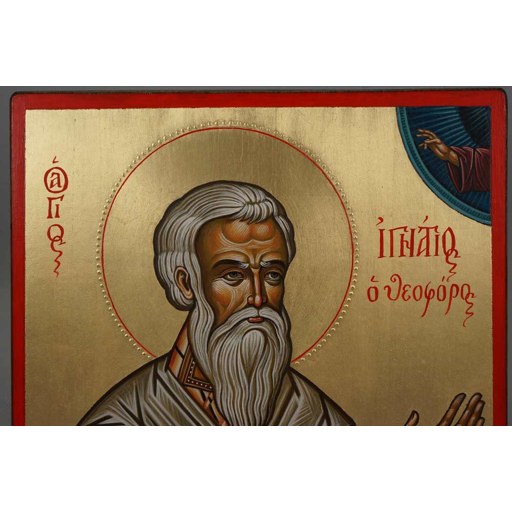
https://www.blessedmart.com/shop/hand-painted-icons/male-saints-icons/saint-ignatius-of-antioch/
License: unknown
Ignatius
Saint- Life Span
- 1491 - 1556 (age 65)
- Feast Day
- 31 July
- Gender
- male
- Church
- Catholic
Places
Roles & Family
Religious Information
Patronage
Society of Jesus;soldiers;spiritual exercises;spiritual retreats;Basque Country;Gipuzkoa
Canonization
Biography
Ignatius of Loyola, born Íñigo López de Oñaz y Loyola in 1491 at the castle of Loyola in the municipality of Azpeitia, in the Basque province of Gipuzkoa under the Crown of Castile, was the youngest of thirteen children of Beltrán Yáñez de Oñaz y Loyola and Marina Sáenz de Licona. The family belonged to the local nobility. Íñigo was trained in a Castilian courtly household and then followed a military path. Contemporary accounts describe him as ambitious, attached to honor, and fond of the literature of knighthood. In May 1521 he took part in the defense of Pamplona. A cannonball shattered his right leg and wounded the left. After painful surgery and a long recovery at Loyola, during which he asked for books of chivalry and was given instead a life of Christ and lives of the saints, he underwent a conversion. He later recalled that thoughts of imitating the saints left him consoled, whereas dreams of courtly fame left him dry. He determined to change his life and thereafter used the name Ignatius, associated with the early bishop-martyr Ignatius of Antioch.
In 1522 he set out as a pilgrim. At the Benedictine abbey of Montserrat he made a general confession, kept a night watch before the altar of the Virgin, and left his sword and dagger in the church. He settled for a time at Manresa, where he begged, fasted, prayed for long hours, and passed through severe scruples and spiritual darkness before finding peace. The notes he kept on the discernment of spirits and on methods of prayer, meditation, and election became the core of the Spiritual Exercises, a retreat of about thirty days divided into four weeks. In 1523 he reached Jerusalem but was not permitted to remain. Convinced that he needed education to help souls, he studied Latin in Barcelona and then arts and theology at Alcalá and Salamanca, where his informal catechizing drew the attention of the Inquisition; he was imprisoned briefly and told to study further before teaching. He moved to Paris, where from 1528 he followed the university course and in 1535 took the Master of Arts degree. There he won as companions Francis Xavier, Pierre Favre, Diego Laínez, Alfonso Salmerón, Nicolás Bobadilla, and Simão Rodrigues. On 15 August 1534, in the chapel of Saint-Denis at Montmartre, they vowed poverty, chastity, and a journey to Jerusalem, with the alternative of placing themselves at the disposal of the pope.
War in the Mediterranean blocked the pilgrimage. The group reunited in Italy. Ignatius and most of his companions were ordained in Venice in 1537. After waiting in vain for a passage to the East, they went to Rome. In 1539 they proposed a new religious order distinguished by a fourth vow of special obedience to the pope regarding missions, by the absence of obligatory choral office, and by a long formation. Pope Paul III approved the Society of Jesus in 1540. Ignatius, elected its first Superior General in 1541, remained in Rome until his death. He opened the Roman College and the German College, supported the work of Francis Xavier in Asia, and sent Jesuits into European universities and courts as well as to Brazil and other missions. He wrote thousands of letters of spiritual and practical direction and slowly completed the Constitutions, which organized the Society around obedience, mobility, and the greater glory of God. The Spiritual Exercises received papal approval in 1548. Plagued by illness for many years, Ignatius died in Rome on 31 July 1556. He had dictated an account of his early life to Luís Gonçalves da Câmara; that narrative, together with his Spiritual Diary and correspondence, is a principal source for his biography.
Beatified by Pope Paul V in 1609 and canonized by Pope Gregory XV on 12 March 1622, Ignatius is commemorated on 31 July. He is honored as founder of the Jesuits and as a teacher of discernment and of ordered prayer. The Spiritual Exercises have shaped Catholic retreat practice for centuries. He is patron of the Society of Jesus, of soldiers, of those engaged in spiritual exercises and retreats, and of the Basque Country. His tomb is in the Church of the Gesù in Rome, the mother church of the order he founded.