Íñigo of Oña is a venerable of the Catholic Church (d. 1057). Íñigo of Oña's feast day is celebrated on 1 June. Íñigo of Oña is the patron saint of Calatayud.
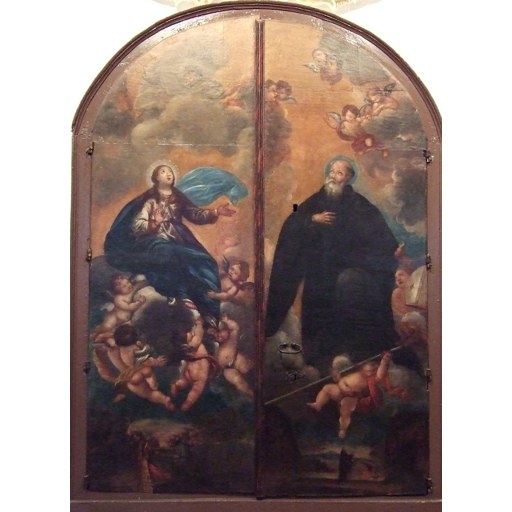
Ecelan, cropped and retouched by Escarlati
License: Public domain
Íñigo of Oña
Venerable- Life Span
- d. 1057
- Feast Day
- 1 June
- Gender
- male
- Church
- Catholic
Places
Relics & Where to Venerate
Location unknown
The bodily remains of Íñigo of Oña are a first-class relic. Venerated at monastery of San Salvador de Oña.
Roles & Family
Religious Information
Patronage
Calatayud
Biography
Íñigo of Oña, also known in Latin as Enecus and in Spanish as San Íñigo de Oña, was an eleventh-century Benedictine monk and abbot in the Christian kingdoms of northern Spain. His personal name is a Romance form of the Basque Eneko, a name well attested among the Navarrese and Aragonese elites of the early Middle Ages. Later hagiographical tradition places his birth at Calatayud in Aragon; no contemporary record of his parentage or of an exact year of birth has survived, and the early part of his life is known only in outline. He is said to have entered the Benedictine monastery of San Juan de la Peña, a major house in the Pyrenean foothills closely associated with the kings of Aragon and Navarre, and thereafter to have left the cloister for a period of eremitical life in the mountains.
In the mid-1030s he was summoned from that solitude to become abbot of San Salvador de Oña, in the Bureba district of Castile. The monastery had been founded in 1011 by Count Sancho García of Castile as a family pantheon and religious establishment. The call to Oña is associated with the reforming climate of the reign of King Sancho III of Navarre, who in the early eleventh century exercised wide hegemony over the Christian north and favored stricter Benedictine observance in the houses under his influence. Sancho III died in 1035, after which Castile passed to his son Ferdinand I; Íñigo’s long abbacy therefore belonged mainly to Ferdinand’s reign. As abbot he is remembered for restoring discipline, regularizing liturgical and conventual life, and giving the house a reputation for austerity and holiness.
Medieval accounts, written or elaborated after his death, credit him with miracles of healing and with spiritual standing at the courts of Navarre and Castile-León. He is frequently paired in Castilian monastic memory with Saint Dominic of Silos, another Benedictine reformer of the same generation. A well-known later legend relates that Dominic reached Oña as Íñigo lay dying and that the abbot briefly revived in order to greet his friend. Such stories belong to the hagiographical tradition rather than to strictly contemporary documentation, but they illustrate the esteem in which both men were held. Independent charter evidence for the details of Íñigo’s administration is limited; what can be said with confidence is that he governed a prominent Castilian abbey for about two decades in a period of monastic reform and dynastic consolidation.
He died at Oña on 1 June 1057 and was buried in the monastic church, where his tomb became a local focus of devotion. His cult spread in Castile and Aragon, and he came to be regarded as the patron saint of Calatayud, the town claimed as his birthplace. His feast is kept on 1 June. The monastery of San Salvador de Oña preserved his relics and memory through the later Middle Ages; the community was later suppressed in the nineteenth-century Spanish disentailment, but the church and the association of the site with the saint remain. Because so much of the narrative of his youth and miracles rests on tradition rather than on eleventh-century sources, the secure historical core of his life is that of a Benedictine abbot of Oña who died in 1057 and whose holiness was recognized in the medieval cult of the region.