Iosif Mnogoboleznennyey is a venerable of the Catholic Church. Iosif Mnogoboleznennyey's feast day is celebrated on 4 April; 28 August (Synaxis of the Fathers of the Far Caves).
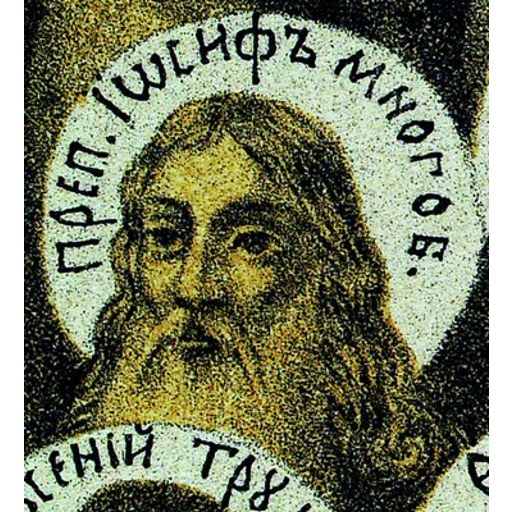
Unknown authorUnknown author
License: CC0
Iosif Mnogoboleznennyey
Venerable- Feast Day
- 4 April; 28 August (Synaxis of the Fathers of the Far Caves)
- Gender
- male
- Church
- Catholic
Places
Relics & Where to Venerate
Location unknown
The bodily remains of Iosif Mnogoboleznennyey are a first-class relic. Venerated at Kyiv Pechersk Lavra.
Roles & Family
Religious Information
Biography
Iosif Mnogoboleznenny (Joseph the Much-Suffering, also rendered Joseph the Much-Ailing; Church Slavonic and Russian: Иосиф Многоболезненный) was an Eastern Orthodox monk of the Kiev Pechersk Lavra, commemorated as a prepodobny (venerable father) in the Orthodox Church. No contemporary charter, chronicle entry, or early Patericon chapter records the year or place of his birth, the names of his parents, or a precise year of death. Later liturgical notices and synaxaria associated with the Far Caves of the Lavra place his life in the fourteenth century, in the period after the Mongol sack of Kiev (1240), when the monastery continued as a centre of Rus' monasticism under changing political overlordship. He is not to be confused with other well-documented Josephs of Rus', such as Joseph of Volokolamsk. Almost everything that can be said of him derives from a short hagiographical notice connected with his relics in the Far Caves (the Caves of St. Theodosius), rather than from the eleventh- and twelfth-century core of the Kiev Caves Patericon.
According to that traditional account, Joseph suffered from a grave illness from his youth. In his affliction he prayed to God and invoked Saint Anthony of the Caves, vowing that if he were restored to health he would take the monastic habit at the Kiev Caves Monastery. He recovered and fulfilled the vow, receiving tonsure at the Lavra. After he had entered monastic life the same illness returned. He bore it for many years without murmuring, giving thanks to God. From this prolonged sickness he received the epithet Mnogoboleznenny, “the much-suffering” or “the much-ailing.” The notice presents his sanctity as consisting in patient endurance of chronic disease within the monastic state, rather than in abbatial office, missionary work, or a cycle of public miracles. No reliable source attributes to him episcopal rank, the office of patriarch or catholicos, or any role as Bishop of Rome or Coptic Pope of Alexandria.
He died at the monastery in Kiev and was buried in the Far Caves. His relics are traditionally numbered among those of the venerable fathers who rest there. The Orthodox Church keeps his individual memory on 4 April (Julian calendar date in the service books of the Russian and Ukrainian Orthodox traditions) and commemorates him again on 28 August with the Synaxis of the Venerable Fathers of the Kiev Caves whose relics lie in the Far Caves. Because he was a professed monk, he is documented as living in the celibate monastic state; no source records a wife or children. The Kiev Caves saints of the Far Caves were venerated locally for a long period before their synaxis was more formally organized in the early modern metropolitanate of Kiev; they are now honoured throughout the Eastern Orthodox world. No single pontiff or patriarch is recorded as the agent of a Western-style canonization or beatification in his case.
The historical setting of a fourteenth-century Caves monk is the Lavra’s survival and recovery after the Mongol invasion, when Kiev itself passed through a succession of political claims (including, later in the century, incorporation into the Grand Duchy of Lithuania) while remaining a spiritual focus for East Slavic Orthodoxy. The Far Caves community is generally associated with a somewhat later stratum of Caves saints than the Near Caves (Anthony’s Caves) of the eleventh and twelfth centuries, which helps explain why Joseph’s dossier is brief and late compared with the classic Patericon lives of Anthony, Theodosius, and their immediate disciples. Beyond the outline of childhood illness, healing in answer to a vow, return of the disease, long patience, death in the monastery, and burial in the Far Caves, further anecdotal detail is not secured by early sources and should not be supplied from later pious expansion.
In the absence of a full medieval vita, Joseph’s place in the calendar is that of a monastic intercessor whose memory is bound to the relic-cult of the Far Caves rather than to a richly documented public career. Claims of an exact birth year, an exact death year, a named birthplace, or a list of formal patronages (places, professions, or illnesses) are not supported by the sources that can be verified. What remains historically and liturgically firm is his identity as a male monk of the Kiev Pechersk Lavra, his traditional fourteenth-century dating, his death and burial at Kiev in the Far Caves, his epithet derived from long sickness borne with thanksgiving, and his two feast days in the Orthodox synaxarion.