Irene Chrysovalantou is a venerable of the Catholic Church. Irene Chrysovalantou's feast day is celebrated on 28 July.
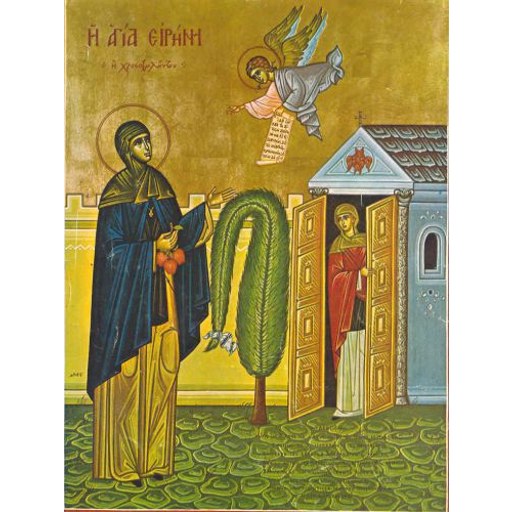
"Icons courtesy of www.eikonografos.com used with permission".
License: Public domain
Irene Chrysovalantou
Venerable- Feast Day
- 28 July
- Gender
- female
- Church
- Catholic
Places
Roles & Family
Biography
Irene of Chrysovalantou, also called Irene of Cappadocia, was a Byzantine abbess and wonderworker of the ninth century, commemorated as a saint by the Eastern Orthodox Church. Tradition holds that she was born to an affluent and well-connected family in Cappadocia, a highland region of Asia Minor within the Byzantine Empire. Almost everything known about her comes from a Greek hagiographical Life, which modern scholars generally date to the tenth or eleventh century rather than to her own lifetime. That text places her in the era of Emperor Theophilos and of the monastery of Chrysovalantou in Constantinople, but it does not supply a verifiable year of birth, and later notices that assign her death to 881 or to 912 are not confirmed by contemporary chronicles. Historians therefore treat her chronology in terms of century and imperial reign rather than exact dates.
According to the Life, Irene was among the noble young women summoned to Constantinople when Theophilos held a bride-show to choose an empress. She arrived after Theodora had already been selected. Remaining in the capital, she visited the monastery of Chrysovalantou, was drawn to the monastic life, gave away her wealth, and received the tonsure. The narrative presents her as a virgin who declined marriage and worldly rank in favor of asceticism. She is described as practicing severe fasting, night-long prayer, and hidden acts of charity, and as advancing in obedience under the abbess who received her.
When that abbess died, the nuns and the ecclesiastical authorities are said to have chosen Irene to govern the community. The Life portrays her as a reluctant but firm superior, combining administrative care for the monastery with spiritual direction of the sisters and of lay visitors. She was credited with discernment of thoughts, prophecy, and the healing of bodily and spiritual ills. Stories attached to her abbacy include the rebuke of a negligent or sinful nun, the protection of the monastery, and prolonged standing in prayer during which she was reported to have been lifted from the ground or surrounded by light. These episodes belong to the miraculous idiom of middle Byzantine saints’ lives.
The most famous miracle associated with her is the gift of three apples from Paradise, allegedly sent by the Apostle and Evangelist John from Patmos through a sailor who was commanded in a vision to deliver them to the abbess of Chrysovalantou. The apples were said to remain incorrupt and fragrant and to be divided for the blessing and healing of those who approached her. Icons of Saint Irene often show her holding one or more apples, and later popular devotion treated fragments of such fruit, or blessed apples on her feast, as tokens of her intercession. Other legends speak of an angel who appeared to teach her the monastic rule and of sailors and pilgrims who received help through her prayers.
Irene is said to have died at a great age in the monastery of Chrysovalantou in Constantinople and to have been buried there. The Eastern Orthodox Church keeps her feast on 28 July. The Constantinopolitan house itself disappeared in the later Middle Ages; her cult was preserved in synaxaria and menologia and was revived in modern times by new monasteries under her patronage, notably in Greece and among Greek communities abroad, some of which claim relics. Because the literary Life is late and filled with conventional miracle topoi, many narrative details cannot be verified independently, yet her identity as a Cappadocian-born abbess of Chrysovalantou and her liturgical commemoration on 28 July are the stable core of the tradition.