Irinarkh of Solovki is a venerable of the Catholic Church (d. 1628). Irinarkh of Solovki's feast day is celebrated on 17 July; 9 August (Synaxis of Solovki Saints).
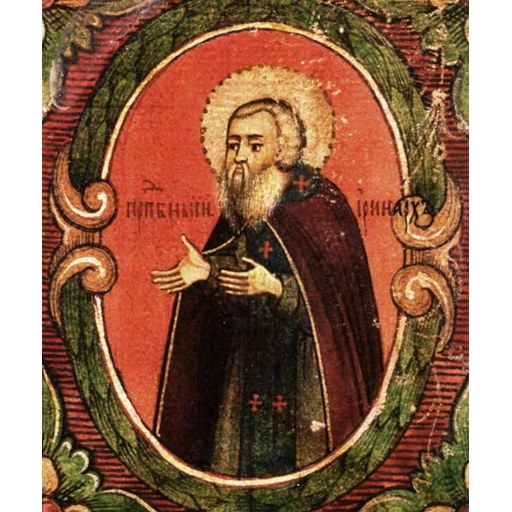
Unknown authorUnknown author
License: Public domain
Irinarkh of Solovki
Venerable- Life Span
- d. 1628
- Feast Day
- 17 July; 9 August (Synaxis of Solovki Saints)
- Gender
- male
- Church
- Catholic
Places
Roles & Family
Canonization
Biography
Irinarkh of Solovki, also rendered Irinarch, was a Russian Orthodox monk and hegumen of the Solovetsky Monastery who lived in the late sixteenth and early seventeenth centuries. He is venerated as a saint of the Russian Orthodox Church with the rank of Venerable (prepodobny). Contemporary archival evidence for his biography is limited, and the details repeated in later synaxaria and monastic commemorations must be treated with caution. Tradition holds that he was born in the second half of the sixteenth century to a peasant family in the Olonets region of the Russian North and that his name in the world was Ivan. As a young man he entered the Solovetsky Monastery on the Solovetsky Islands in the White Sea, by then a major cenobitic house, fortress, and economic center of Muscovite Russia, and received the monastic tonsure with the name Irinarkh.
Monastic accounts describe him as notable for humility, obedience, and ascetic discipline. He was appointed cellarer, an office that placed him in charge of the monastery’s provisions and a substantial part of its economic life. In 1613, just as the Time of Troubles was ending and the Romanov dynasty was being established, the brethren elected him hegumen. He remained abbot until 1626. During these years the monastery continued to function as a spiritual community and as a fortified outpost of the Muscovite state on the White Sea; it had stayed loyal to Moscow through the dynastic crisis and the foreign interventions of the early seventeenth century. Independent documentation of specific building campaigns or administrative acts under his rule is relatively sparse when compared with the records associated with earlier abbots such as Saint Philip Kolychev.
After relinquishing the abbacy in 1626, Irinarkh remained at Solovki. Church tradition gives the date of his death as 17 July 1628. He was buried at the monastery. He is a different person from Saint Irinarch the Recluse of Rostov (died 1616), a more widely known contemporary ascetic of the Borisoglebsky Monastery.
Local veneration of Irinarkh developed at the Solovetsky Monastery. He is commemorated on 17 July, the traditional day of his repose, and together with the other saints of Solovki on the Synaxis of the Solovetsky Saints (9 August in the Julian calendar). His relics were kept at the monastery. Much of the portrait given in later liturgical texts follows conventional hagiographical patterns for a venerable abbot, and historians must distinguish those conventions from the modest number of facts that can be anchored in the history of the house in the early Romanov period.