Isaac of the Caves is a venerable of the Catholic Church (d. 1090). Isaac of the Caves's feast day is celebrated on 14 February.
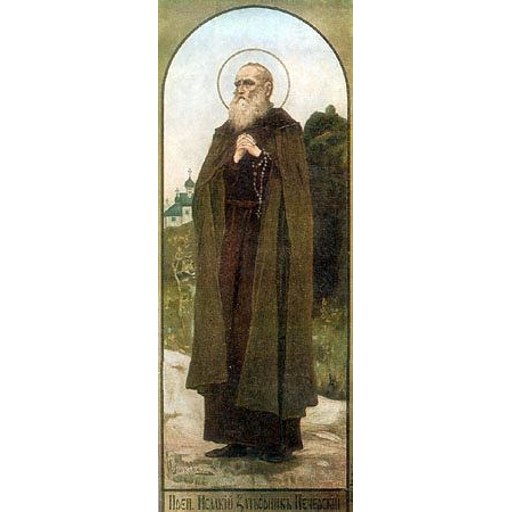
Viktor Vasnetsov (1848—1926)
License: Public domain
Isaac of the Caves
Venerable- Life Span
- d. 1090
- Feast Day
- 14 February
- Gender
- male
- Church
- Catholic
Places
Relics & Where to Venerate
Location unknown
The bodily remains of Isaac of the Caves are a first-class relic. Venerated at Kyiv Pechersk Lavra.
Roles & Family
Biography
Isaac of the Caves, also called Isaac the Recluse, was an eleventh-century monk of the Kiev Pechersk Lavra (Monastery of the Caves) in Kievan Rus'. The principal source for his life is the Kiev Caves Patericon, a collection of narratives about the early brethren of the lavra assembled in the thirteenth century from older monastic tradition. According to that account he had been a wealthy merchant of the town of Toropets. He distributed his property to the poor, came to the caves near Kiev, and was received and tonsured by Saint Anthony of the Caves. Seeking a stricter ascesis, he had himself enclosed as a recluse in a narrow cave cell and remained there for seven years, taking only a little bread and water.
The Patericon then records a severe episode of demonic deception, later often cited in Orthodox spiritual writing as an example of prelest (spiritual delusion). Demons appeared to him as radiant angels, and one in the likeness of Christ, inviting him to worship. After he bowed down they tormented him with music and dance and left him barely alive. Saint Anthony found him in this state and had him carried from the cave. For a long time Isaac remained helpless, unable to walk, sit, speak, or feed himself, and had to be tended like an infant. Care passed from Anthony to Saint Theodosius of the Caves, who died in 1074 while Isaac was still infirm.
After Theodosius’s death Isaac gradually recovered the use of his body and lived among the brethren rather than in strict enclosure. He took menial work in the kitchen, endured mockery and blows, and practiced a form of foolishness for Christ’s sake. The Patericon describes further demonic apparitions which he now resisted with the sign of the cross and prayer, invoking the God of Anthony and Theodosius. Later church tradition dates his death to 1090. He was buried at the Monastery of the Caves; his relics rest in the Near Caves associated with Saint Anthony.
He is venerated in the Eastern Orthodox Church. His principal feast is 14 February; he is also commemorated on 28 September with the Synaxis of the Venerable Fathers of the Kiev Near Caves and on the Second Sunday of Great Lent with all the saints of the Kiev Caves. No contemporary act naming a specific hierarch as canonizer is known; his cult belongs to the early local veneration of the Pechersk fathers, later received throughout the Orthodox Church. His story has been used as a warning against trusting extraordinary visions without discernment and as an example of recovery through communal care and humility.