Isaiah of Rostov is a saint of the Catholic Church (d. 1090). Isaiah of Rostov's feast day is celebrated on 15 May.
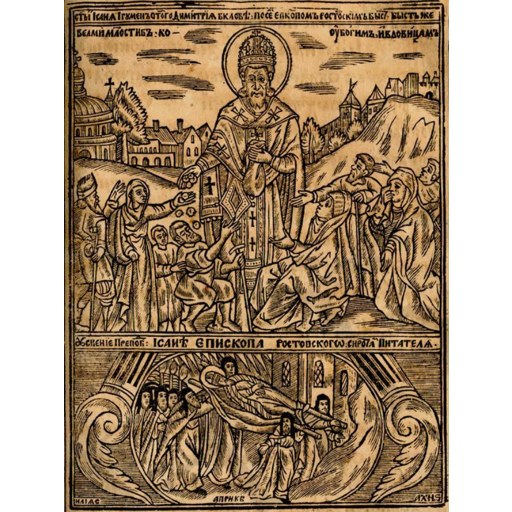
монах, ксилограф Илия
License: Public domain
Isaiah of Rostov
Saint- Life Span
- d. 1090
- Feast Day
- 15 May
- Gender
- male
- Church
- Catholic
Places
Relics & Where to Venerate
Location unknown
The bodily remains of Isaiah of Rostov are a first-class relic. Venerated at Yaroslavl Oblast.
Roles & Family
Religious Information
Biography
Saint Isaiah of Rostov was an eleventh-century monk-bishop of the church of Kievan Rus', later venerated in the Russian Orthodox Church as a missionary hierarch of the Rostov land. No reliable source records his year or place of birth, nor the names of his parents. He enters the historical record as a monk of the Kiev Pechersk Lavra, the Monastery of the Caves at Kiev, during the abbacy of Saint Theodosius of the Caves. That house was the chief centre of Orthodox monasticism in Rus' in the mid-eleventh century, and it regularly supplied bishops for distant northern sees. Isaiah’s life in the Lavra is described in later hagiographic tradition as one of ascetic discipline; the sources present him throughout as a celibate monk and do not mention a wife or children.
After the death of Saint Leontius of Rostov, who had been killed while preaching among the still pagan population of the northeast, the Rostov cathedra required a successor. In the later 1070s, commonly dated to 1077, Isaiah was consecrated Bishop of Rostov by Metropolitan John of Kiev. Rostov, on Lake Nero, was then a frontier diocese of Kievan Rus' whose Slavic and Finnic inhabitants, including the Merya, had only partly accepted Christianity. Isaiah continued the mission associated with Leontius: later lives and local tradition credit him with destroying pagan sanctuaries, raising churches, baptizing converts, and travelling through the surrounding districts in order to establish a more stable Christian presence.
His episcopate fell in the generation after Yaroslav the Wise, when church building and the organisation of northern dioceses were still in progress. Some accounts place him among the hierarchs who attended the consecration of the great Dormition church of the Kiev Caves Monastery on 14 August 1089, an event that, if correctly reported, shows he was still alive in the summer of that year. He died on 15 May 1090 and was buried at Rostov. Older notices sometimes give 1089 as the year of death, but his reported presence at the August 1089 consecration makes 1090 the more consistent date.
In 1164, during reconstruction of the cathedral church of the Dormition at Rostov, his relics were said to have been found incorrupt, together with those of Saint Leontius, and they were thereafter venerated in that cathedral. The Russian Orthodox Church commemorates him on 15 May and also remembers him with the synaxis of the Rostov saints. He held the office of diocesan bishop only; he was never pope or patriarch. Formal Western-style acts of beatification or papal canonization do not apply to his cult, which grew from local veneration after the twelfth-century finding of the relics. Surviving sources do not assign him a documented list of specific patronages beyond his association with the church of Rostov.