Isidore is a saint of the Catholic Church (d. 636). Isidore's feast day is celebrated on 4 April. Isidore is the patron saint of the Internet;computer users;computer technicians;programmers;students.
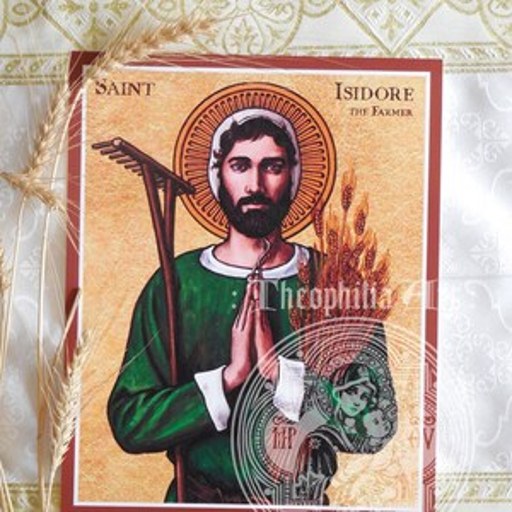
https://www.etsy.com/market/st_isidore_icon
License: unknown
Isidore
Saint- Life Span
- d. 636
- Feast Day
- 4 April
- Gender
- male
- Church
- Catholic
Places
Roles & Family
Patronage
the Internet;computer users;computer technicians;programmers;students
Canonization
Biography
Isidore of Seville, known in Latin as Isidorus Hispalensis, was Archbishop of Seville in Visigothic Hispania during the late sixth and early seventh centuries and is counted among the last of the Western Church Fathers and a Doctor of the Church. He belonged to a prominent Hispano-Roman family associated with Cartagena on the Mediterranean coast; political upheaval in that region led the family to settle in Seville. His elder brother Leander became Archbishop of Seville and was a principal agent in the conversion of the Visigothic kings from Arianism to Catholic Christianity, corresponding with Pope Gregory the Great and influencing King Reccared. Another brother, Fulgentius, became bishop of Écija (Astigi), and their sister Florentina was an abbess who received a rule from Leander. Precise details of Isidore’s own birth—including the exact year and whether he was born in Cartagena or already in Seville—are not securely documented in contemporary sources; historians generally place his birth in the mid-sixth century.
Formed in Leander’s household, Isidore received a wide education in Scripture, patristic theology, and the remnants of the classical liberal arts at a time when much of the old Roman educational infrastructure had collapsed. When Leander died around 600, Isidore succeeded him as metropolitan archbishop of Seville and held that see until his death more than three decades later. In that office he worked to complete the Catholic unification of the Visigothic church, to strengthen episcopal discipline, and to make Seville a center of learning. He was a leading figure at the Second Council of Seville in 619, which dealt with doctrinal and jurisdictional questions, and he presided over the Fourth Council of Toledo in 633. That council, attended by many bishops of the kingdom, issued canons of lasting importance for a common liturgy, for the education of clergy (including the establishment of cathedral schools), and for the political-religious identity of the Visigothic monarchy.
Isidore’s enduring historical importance lies in his vast literary production, conceived as a rescue and reorganization of knowledge for a post-Roman Christian society. The Etymologiae, or Origines, in twenty books, is an encyclopedia ranging from the trivium and quadrivium through medicine, law, natural history, geography, and theology, often proceeding by etymological explanation; it was copied throughout medieval Europe and shaped how later centuries understood the ancient world. He also wrote the Historia de regibus Gothorum, Vandalorum et Suevorum, a principal narrative source for the barbarian kingdoms in Spain; the Sententiae, a manual of doctrine and morals; De fide catholica contra Iudaeos; De natura rerum; a monastic rule; treatises on the Bible, the offices of the church, and grammar; and other works. His method was typically compilatory rather than speculative: he excerpted, arranged, and Christianized earlier authorities so that they would remain available.
Isidore died in Seville on 4 April 636. Cultus developed early in the Iberian Peninsula. In 1063, during the Reconquista period, King Ferdinand I of León obtained his relics from Seville, then under Muslim rule, and enshrined them in León, where the Basilica of San Isidoro became a major pilgrimage church. Medieval and early modern Spain regarded him as a national teacher and saint. In 1722 Pope Innocent XIII formally declared him a Doctor of the Church. In 1997 he was named patron saint of the Internet and of computer users, an attribution that recalls his medieval role as the great organizer and transmitter of knowledge. The Roman Catholic Church keeps his feast on 4 April.