Issidor is a saint of the Eastern Orthodox Church.
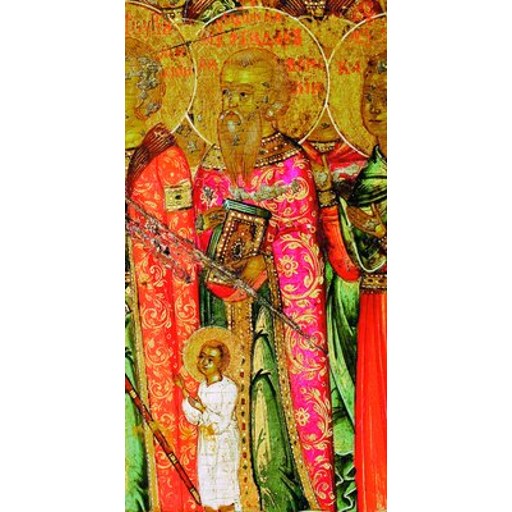
unknown painter XVIII-XIX c.
License: Public domain
Issidor
Saint- Church
- Eastern Orthodox
Biography
The individual listed as Issidor under Wikidata identifier Q4203788 cannot be matched with certainty to one documented historical person from standard church-historical and hagiographical sources. Issidor is a spelling variant of Isidore (Greek Isidoros, “gift of Isis”), a theophoric name borne by many clerics, monks, and martyrs in Eastern Orthodox, Oriental Orthodox, and Latin traditions from late antiquity through the early modern period. The identifier and the bare name together do not isolate a single vita, see, or century, so no birth year, death year, or place can be verified without risk of substituting another man’s dates.
Figures who have carried this name include the third-century martyr Isidore of Chios; the fifth-century monastic writer Isidore of Pelusium in Egypt; Isidore of Seville, bishop and encyclopedist in Visigothic Spain in the early seventh century; the Russian fool-for-Christ Isidore of Rostov in the fifteenth century; the priest-martyr Isidore of Yuriev (Tartu), drowned with parishioners in 1472; and two patriarchs of Constantinople named Isidore in the fourteenth and fifteenth centuries. Any equation of Q4203788 with one of these men, or with a still more obscure local hierarch or new martyr, would be conjecture rather than established fact.
Because identity remains unverified, marital status, children, religious order, patronage, and the precise offices of pope or patriarch cannot be asserted. Feast days attached to various Isidores fall on different dates in January, February, April, and May depending on the calendar; none can be assigned here. Liturgical memory of an obscure Issidor, if it exists, would most likely survive in a synaxarion, menologion, or local diocesan calendar rather than in a detailed contemporary biography.
In accordance with the rule that an empty field is preferable to an erroneous one, the biographical particulars are therefore left blank. Direct inspection of the Wikidata item, of corresponding Wikipedia language editions, or of specialized Orthodox and Catholic calendars would be required before any of those fields could be filled with confidence. What can be stated is only that the name itself belongs to a large family of early-Christian names that remained in continuous ecclesiastical use around the Mediterranean, in the Slavic lands, and in Western Europe.