Iuliu Hossu is a blessed of the Catholic Church (1885 - 1970). Iuliu Hossu's feast day is celebrated on 2 June.
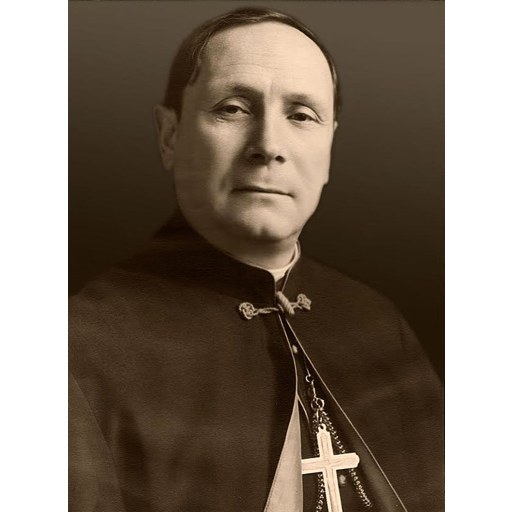
Unknown authorUnknown author
License: Public domain
Iuliu Hossu
Blessed- Life Span
- 1885 - 1970 (age 85)
- Feast Day
- 2 June
- Gender
- male
- Church
- Catholic
Places
Relics & Where to Venerate
Location unknown
The bodily remains of Iuliu Hossu are a first-class relic. Venerated at Cimitirul Bellu Catolic.
Roles & Family
Canonization
Biography
Iuliu Hossu was born on 30 January 1885 in the Transylvanian village of Milașu Mare (today Milaș, in Bistrița-Năsăud County), then part of Austria-Hungary. He came from a Romanian Greek-Catholic family of clergy; his father, Ioan Hossu, was a parish priest. After early schooling in Transylvania he studied at the Greek-Catholic seminary in Blaj, continued theology in Budapest, and was sent to Rome, where he attended the Pontifical Urban College of Propaganda Fide and obtained doctorates in philosophy and theology. He was ordained a priest in Rome on 27 March 1910. Returning to Transylvania he took up pastoral and administrative duties and, after the outbreak of the First World War, served as a military chaplain to Romanian soldiers in the Austro-Hungarian army.
In 1917 Pope Benedict XV appointed him Bishop of Gherla, and he received episcopal consecration the same year, while still in his early thirties. On 1 December 1918, at the Great National Assembly in Alba Iulia, Bishop Hossu read the resolution by which the Romanians of Transylvania and Hungary proclaimed union with the Kingdom of Romania, an act that made him a lasting public figure in modern Romanian history. As a bishop he later sat in the Romanian Senate by right of office. In 1930 the Holy See transferred the episcopal residence from Gherla to Cluj and the diocese was renamed Cluj-Gherla, which he continued to govern. His long episcopate was devoted to pastoral organization, Catholic education, and the defense of the Greek-Catholic community in Transylvania, including during the territorial upheavals of 1940, when Northern Transylvania was awarded to Hungary.
After the Second World War, as the communist regime consolidated power, the Romanian state moved to suppress the Romanian Greek-Catholic Church and to force its clergy and faithful into the Romanian Orthodox Church. Hossu refused to break communion with Rome. In October 1948 he was arrested together with the other Greek-Catholic bishops. He was held at Dragoslavele, at Căldărușani monastery, and from 1950 in the political prison at Sighetu Marmației, where several of his fellow bishops died. From the mid-1950s he was confined under guard in Orthodox monasteries, including Curtea de Argeș, Ciorogârla, and again Căldărușani, remaining a prisoner until his death. Throughout more than two decades of detention he maintained his episcopal identity and loyalty to the Holy See.
Pope Paul VI created Hossu a cardinal in pectore at the consistory of 1969; the nomination was made public only after his death. Iuliu Hossu died on 28 May 1970 in Bucharest, still in custody, and was buried in the Bellu Cemetery in that city. On 2 June 2019, during an apostolic visit to Romania, Pope Francis beatified him at Blaj together with six other Romanian Greek-Catholic bishops who had died under communist detention, recognizing them as martyrs. Their liturgical memorial is observed on 2 June. Hossu is remembered both as a witness of the suppressed Greek-Catholic Church and as the bishop who proclaimed the 1918 union of Transylvania with Romania.