James Miller is a venerable of the Catholic Church (1944 - 1982). James Miller's feast day is celebrated on 13 February.
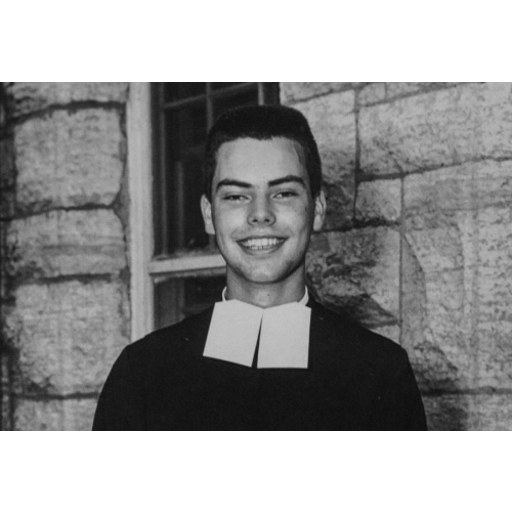
La imagen de la fotografía fue donada por la familia para el proceso de beatificación.
License: CC BY-SA 4.0
James Miller
Venerable- Life Span
- 1944 - 1982 (age 38)
- Feast Day
- 13 February
- Gender
- male
- Church
- Catholic
Places
Roles & Family
Religious Information
Canonization
Biography
James Alfred Miller was born on 21 September 1944 in Stevens Point, Wisconsin, in the United States, and grew up on a family farm in the rural Portage County countryside nearby. He attended Catholic schools in the area, including Pacelli High School in Stevens Point, which was staffed by the De La Salle Christian Brothers. The Brothers’ combination of classroom teaching, community life, and practical service attracted him to a religious vocation. In the early 1960s he entered the Institute of the Brothers of the Christian Schools, the congregation founded by Saint John Baptist de La Salle. In formation he took the religious name Brother Leo William, though he was later generally known as Brother James and, in Latin America, as Hermano Santiago. He studied at Saint Mary’s College in Winona, Minnesota, and prepared for a life that would mix teaching with the manual labor of building and maintaining schools.
After religious profession he taught at Cretin High School in Saint Paul, Minnesota, where he gave classes in Spanish, English, and religion and also coached sports. Students and fellow Brothers remembered him as physically strong, informal in manner, and as ready to repair a building as to prepare a lesson. In 1969 he was sent to the Brothers’ missions in Nicaragua. He taught and helped construct and expand school facilities in Bluefields and later in Puerto Cabezas on the Caribbean coast, working among poor coastal communities. Besides academic instruction he oversaw building projects and encouraged agricultural work so that students might gain useful skills. Nicaragua in those years suffered natural disaster, including the effects of a devastating earthquake, and then deepening political conflict that led to the Sandinista revolution. The Brothers continued their schools under increasingly dangerous conditions. As violence grew, Miller returned to the United States, taught again in Minnesota, and completed further studies connected with Saint Mary’s in Winona.
In 1981 he accepted assignment to Guatemala, then in the midst of a long and exceptionally brutal civil war. He was posted to the Casa Indígena De La Salle in Huehuetenango, a boarding school for indigenous Maya boys. The Brothers’ work of giving indigenous youth a serious education was regarded with hostility by elements of the security forces and by those who saw independent indigenous leadership as a threat. Miller taught, supervised students, and again took on construction and repair around the campus. On 13 February 1982, in the late afternoon, he was standing on a ladder repairing an exterior wall of the school that faced the street when unidentified gunmen shot him repeatedly. He died at the scene at the age of thirty-seven. No one was ever convicted of the killing. Church investigations and contemporary testimony treated the murder as an extrajudicial assassination aimed at the Christian Brothers’ educational work among indigenous people, and therefore as martyrdom in hatred of the faith as lived through Catholic schooling and solidarity with the poor.
His body was returned to Wisconsin and buried at Saint Martin Cemetery in Ellis. Devotion to him took root among the De La Salle Brothers, in his home region, and in Guatemala, where he was remembered as a teacher who remained with his students in a time of terror. After examination of his life and of the circumstances of his death, Pope Francis recognized his martyrdom. He was beatified on 7 December 2019 at a ceremony in Huehuetenango, celebrated in the Pope’s name. Blessed James Miller is commemorated as a martyr of Christian education and of the Church’s stand with indigenous and poor communities in Central America. His memory is kept especially on the anniversary of his death, and he remains for his Institute an example of a religious brother whose ordinary work of teaching and building became a witness sealed by violence.