Jason is a saint of the Catholic Church. Jason's feast day is celebrated on 28 April.
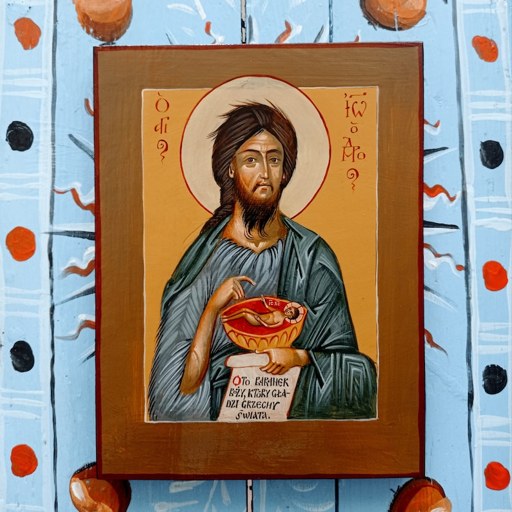
https://www.etsy.com/uk/listing/1518487637/saint-john-the-baptist-picture-icon
License: unknown
Jason
Saint- Feast Day
- 28 April
- Gender
- male
- Church
- Catholic
Roles & Family
Biography
The name Jason appears in the New Testament in connection with the earliest Christian communities of the Aegean. In the Acts of the Apostles, a man named Jason is a resident of Thessalonica who received Paul and Silas into his house during their mission in Macedonia, conventionally placed in the mid-first century. When opponents of the missionaries gathered a crowd and attacked the house, they did not find Paul and Silas, but dragged Jason and some of the brethren before the city authorities (the politarchs). The charge was that they harbored men who were turning the world upside down and acting contrary to the decrees of Caesar by proclaiming another king, Jesus. Jason and the others were released after giving security. Independently, a Jason is named among those who send greetings in the Epistle to the Romans (16:21), where he is called a kinsman of Paul. Whether the host in Thessalonica and the kinsman in Romans are the same person cannot be demonstrated from the texts themselves.
Nothing in the New Testament records Jason’s birthplace, family, later career, or death. Later Greek tradition, especially in synaxaria and related collections, identified him with one of the Seventy Apostles and with a missionary bishop. According to that tradition he was a native of Tarsus in Cilicia and was appointed bishop of Tarsus. Together with Sosipater (sometimes identified with the Sopater of Berea mentioned in Acts 20:4), he is said to have preached on the island of Corfu (Kerkyra). These identifications are ecclesiastical tradition rather than independently verified biography; they should not be treated as established first-century fact.
The legendary cycle associated with Corfu recounts the conversion of the island, the imprisonment of Jason and Sosipater, miraculous events in prison (including the taming or destruction of a serpent or dragon), and the conversion of a king’s daughter who is given the name Kerkyra and later commemorated as a martyr. That cycle is of a late and legendary character. It cannot be used as historical reportage for dates, places of death, or burial. No contemporary source records a papal or patriarchal office, membership in a religious order, or a documented marriage or children.
The historical Jason of Acts remains, on the evidence of the New Testament, a Thessalonian Christian of some standing who was willing to shelter missionaries and to face civic accusation for doing so. The Eastern churches commemorate Saints Jason and Sosipater, commonly on 28 April (with related observances on nearby dates in some calendars), presenting them as apostles of the Seventy and as evangelizers of Corfu. Western martyrologies have also recorded the pair, though with less prominence, sometimes on 12 July. No reliable source supplies a year of birth or death, a verified birth or death city, or a historically documented list of patronages. Formal papal canonization or beatification in the later medieval or modern sense does not apply to a first-century figure whose cult, insofar as it exists, is ancient and pre-congregational.