Jean de Brébeuf is a saint of the Catholic Church (1593 - 1649). Jean de Brébeuf's feast day is celebrated on 19 October. Jean de Brébeuf is the patron saint of Canada.
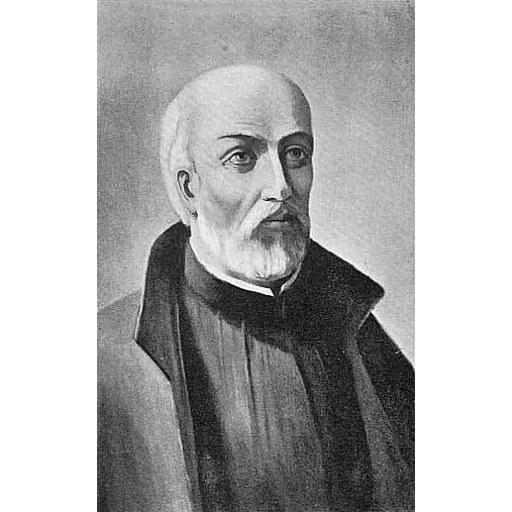
Thwaites, Reuben Gold, 1853-1913
License: Public domain
Jean de Brébeuf
Saint- Life Span
- 1593 - 1649 (age 56)
- Feast Day
- 19 October
- Gender
- male
- Church
- Catholic
Places
Relics & Where to Venerate
Location unknown
The bodily remains of Jean de Brébeuf are a first-class relic. Venerated at National Shrine of North American Martyrs.
Roles & Family
Religious Information
Patronage
Canada
Canonization
Biography
Jean de Brébeuf was born in 1593 at Condé-sur-Vire in Normandy, into a family of the provincial nobility. He entered the Jesuit novitiate at Rouen in 1617, completed his formation in the Society of Jesus, and was ordained priest in 1622. After teaching at the Jesuit college in Rouen he was assigned to the missions of New France and reached Quebec in 1625. He spent a winter among the Montagnais (Innu) and in 1626 travelled inland to the country of the Huron-Wendat on Georgian Bay, becoming one of the first Europeans to reside for a long period among the Wendat.
The Wendat gave him the name Echon. He showed a marked gift for their language and produced a grammar, a dictionary, and translations of prayers and a catechism that later missionaries continued to use. The English occupation of Quebec from 1629 to 1632 forced him back to France; he returned in 1633 and thereafter worked mainly in Huronia. With other Jesuits he helped establish the residence of Sainte-Marie among the Hurons, near present-day Midland, Ontario, as a base for the mission. Epidemics of European disease in the 1630s killed a large part of the Wendat population and at times turned suspicion against the missionaries. Brébeuf continued to instruct, baptize, and describe Huron life in letters published in the Jesuit Relations. He is traditionally credited with composing, in Wendat, the Christmas hymn later known as the Huron Carol (Jesous Ahatonhia).
In the 1640s war between the Huron confederacy and the Haudenosaunee (Iroquois) intensified. In March 1649 Iroquois forces overran the mission villages of Saint-Louis and Saint-Ignace. Brébeuf and his fellow Jesuit Gabriel Lalemant were captured and taken to Saint-Ignace, where on 16 March 1649 both were tortured and killed. Contemporary Jesuit accounts, based on Huron survivors, describe prolonged ritual torture. Brébeuf was in his mid-fifties. His body was recovered and buried at Sainte-Marie; when the Jesuits abandoned Huronia in 1650 they carried the bones of Brébeuf and Lalemant to Quebec.
He was beatified by Pope Pius XI in 1925 and canonized by the same pope on 29 June 1930, together with seven companions known as the Canadian Martyrs or North American Martyrs. Their feast is kept on 19 October in the General Roman Calendar and on 26 September in Canada. In 1940 they were named secondary patrons of Canada. Relics associated with Brébeuf are preserved at the Martyrs' Shrine near Midland, Ontario, and in Quebec. His linguistic work and the Relations remain important sources for the history of the Wendat and of seventeenth-century New France.