Jeanne de Lestonnac is a saint of the Catholic Church (1556 - 1640). Jeanne de Lestonnac's feast day is celebrated on 15 May.
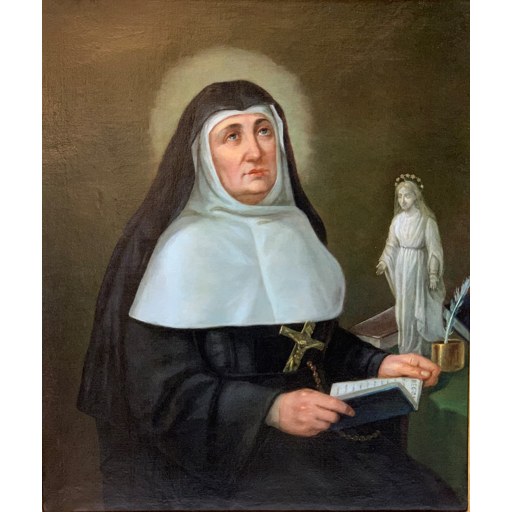
Unknown authorUnknown author
License: Public domain
Jeanne de Lestonnac
Saint- Life Span
- 1556 - 1640 (age 84)
- Feast Day
- 15 May
- Gender
- female
- Church
- Catholic
Places
Roles & Family
Religious Information
Canonization
Biography
Jeanne de Lestonnac was born in Bordeaux on 27 December 1556, into a family of the noblesse de robe at a moment when Guyenne was torn by the French Wars of Religion. Her father, Richard de Lestonnac, sat in the Parlement of Bordeaux and remained a Catholic; her mother, Jeanne Eyquem de Montaigne, sister of the essayist Michel de Montaigne, had converted to Calvinism. The contrast of confessions within the household was typical of the Bordelais elite. Jeanne was baptized and raised Catholic. Later hagiography emphasizes that she resisted her mother's attempts to win her to the Reformed religion. Through her uncle she was exposed to Renaissance humanism, and she received a more substantial education than was common for girls of her rank in sixteenth-century France.
At about seventeen she married Gaston de Montferrand, Baron of Landiras, a match that allied two regional families. Over some twenty-four years of marriage they had seven children; several died in childhood, a loss that marked her later spirituality. Gaston died in 1597. After arranging the futures of her surviving children, she turned toward religious life. In the early seventeenth century she entered a Cistercian monastery in Toulouse, seeking a reformed observance. The physical demands of that life quickly undermined her health, and she was dispensed from remaining. The experience convinced her that a different form of women's religious life was needed, one less strictly modelled on medieval enclosure and able to address the education of girls, which the wars and the Protestant challenge had made a pastoral priority in Catholic Bordeaux.
With the support of Jesuit confessors and of Cardinal François d'Escoubleau de Sourdis, Archbishop of Bordeaux, she established in 1607 a community that became the Compagnie de Notre-Dame, known in English as the Company of Mary, Our Lady. The new institute combined a religious rule with the conduct of schools for girls of various social conditions. Its structure borrowed from the Society of Jesus—formation, governance, and an active apostolate—while remaining an order of women under diocesan and then papal oversight. Houses multiplied in Aquitaine and beyond during her lifetime. Jeanne was the first superior general. In the 1620s internal disputes, involving questions of authority and accusations against her, led to her removal from office and a period of humiliation and relative isolation within her own congregation. She accepted the trial and was later restored to honor. She died in Bordeaux on 2 February 1640, in her eighty-fourth year.
Devotion to her remained largely confined to her order and to Bordeaux until the nineteenth century. A canonical process culminated in her beatification by Pope Leo XIII on 23 September 1900 and her canonization by Pope Pius XII on 15 May 1949. The Company of Mary, Our Lady, continues educational work in many countries. In the liturgical calendar her memory is commonly kept on 15 May, the anniversary of her canonization, though some local calendars retain 2 February, the day of her death.