Jerome is a saint of the Catholic Church (d. 420). Jerome's feast day is celebrated on 30 September. Jerome is the patron saint of archaeologists;archivists;Bible scholars;librarians;libraries;schoolchildren;students;translators.
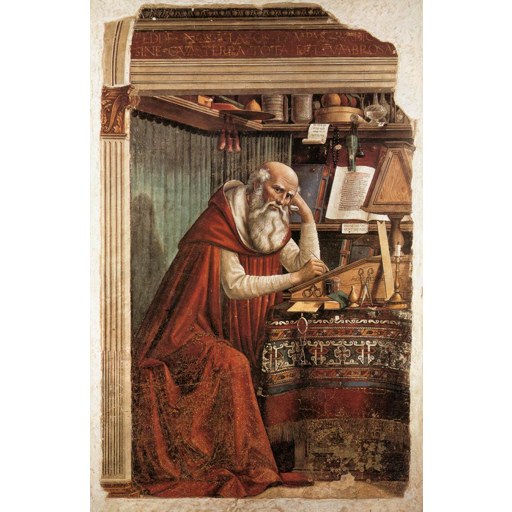
Domenico Ghirlandaio
License: Public domain
Jerome
Saint- Life Span
- d. 420
- Feast Day
- 30 September
- Gender
- male
- Church
- Catholic
Places


Relics & Where to Venerate
Location unknown
The bodily remains of Jerome are a first-class relic. Venerated at Bethlehem.
Roles & Family
Patronage
archaeologists;archivists;Bible scholars;librarians;libraries;schoolchildren;students;translators
Canonization
Biography
Jerome, whose full Latin name was Eusebius Sophronius Hieronymus, was a priest, monk, biblical translator, and theologian of the late fourth and early fifth centuries, later recognized as a Doctor of the Church. He was born at Stridon, a town he himself located on the frontier between the Roman provinces of Dalmatia and Pannonia; the settlement was subsequently destroyed by Gothic raids, and its exact site has never been identified with certainty. Sent as a youth to Rome, he received a thorough education in grammar and rhetoric under the celebrated teacher Aelius Donatus and became intimately familiar with Latin classical literature. After a period of secular life in the city he was baptized, and he then turned toward an ascetic Christian path, spending time at Trier, where he copied works of Hilary of Poitiers, and among a community of like-minded clergy and laypeople at Aquileia.
Seeking a stricter monastic discipline, Jerome traveled eastward to Antioch and withdrew for several years as a hermit into the desert of Chalcis in Syria. There he endured harsh physical austerities, continued his study of Greek, and began to learn Hebrew with the help of a Jewish convert, an unusual undertaking for a Latin Christian of his time. He was ordained to the priesthood by Paulinus of Antioch on the understanding that he would not be bound to parish ministry. After attending the lectures of Gregory of Nazianzus in Constantinople and translating into Latin portions of Origen and the chronicle of Eusebius of Caesarea, he returned to Rome in 382. Pope Damasus I made him a papal secretary and asked him to revise the Old Latin translations of the Gospels against the Greek, the first stage of the version later known as the Vulgate. In Rome Jerome also became the spiritual director of a circle of noblewomen devoted to Scripture and asceticism, among them Marcella, Paula, and Paula's daughter Eustochium.
Following the death of Damasus, Jerome encountered strong opposition in Rome and departed in 385. After pilgrimage in the Holy Land and a visit to the monks of Egypt, he settled permanently at Bethlehem. There, with the financial support of Paula, a monastery for men, a convent for women, and a hospice for pilgrims were established. Jerome resided in Bethlehem for the rest of his life, combining monastic observance with intense literary labor. He translated the Old Testament into Latin from the Hebrew text rather than from the Greek Septuagint, revised the New Testament, and composed commentaries on many biblical books, a continuation of Eusebius's Chronicle, the catalogue De viris illustribus, hagiographical lives, and a large correspondence. He also wrote vigorous polemical treatises against Helvidius, who denied the perpetual virginity of Mary; against Jovinian, who equated marriage with consecrated virginity; against Vigilantius; against Origenist theology; and, in his last years, against Pelagianism.
Jerome died at Bethlehem, traditionally on 30 September 420, and was buried there. In later centuries relics associated with him were said to have been translated to the basilica of Santa Maria Maggiore in Rome. The Latin Bible that resulted from his work, the Vulgate, became the ordinary scriptural text of the Western Church and was affirmed as authentic by the Council of Trent in the sixteenth century. He is honored as a saint by the Catholic Church, the Eastern Orthodox Church, and Anglican and Lutheran communities, and Pope Boniface VIII numbered him among the four Great Latin Doctors of the Church. His principal feast is kept on 30 September. Because of his lifelong work of translation, commentary, and the gathering of texts, he is invoked as patron of translators, librarians, archivists, biblical scholars, and students.