Joachim of Fiore is a blessed of the Catholic Church (d. 1202).
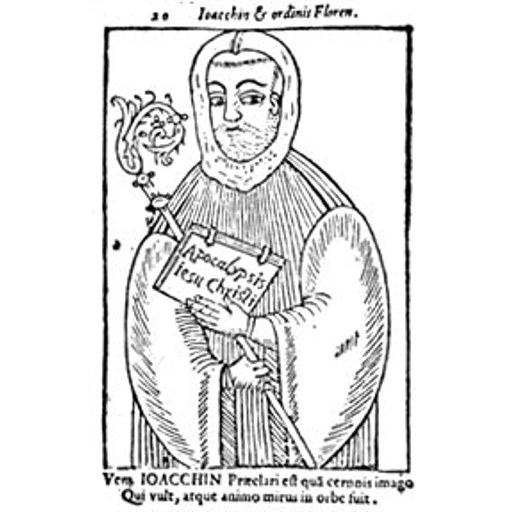
License: Public domain
Joachim of Fiore
Blessed- Life Span
- d. 1202
- Gender
- male
- Church
- Catholic
Places
Relics & Where to Venerate
Location unknown
The bodily remains of Joachim of Fiore are a first-class relic. Venerated at San Giovanni in Fiore Abbey.
Roles & Family
Religious Information
Biography
Joachim of Fiore, known in Italian as Gioacchino da Fiore, was a Calabrian abbot, biblical commentator, and mystical theologian whose reading of Scripture as a key to the unfolding of history became one of the most influential apocalyptic systems of the later Middle Ages. He was born in the village of Celico, near Cosenza in Calabria, then part of the Norman Kingdom of Sicily; an exact year of birth is not securely attested in contemporary sources. His father Mauro was a notary, and Joachim himself was trained for administrative work, serving for a time at the Sicilian royal court. A pilgrimage to the Holy Land in the mid-twelfth century, commonly dated to about 1159 or 1160, brought about a lasting conversion. After his return he lived as a hermit and preacher in Calabria before entering the Cistercian milieu, first in connection with Sambucina and then at the monastery of Corazzo, of which he became abbot in the later 1170s.
Burdened by office and intent on study, he obtained from Pope Lucius III and later pontiffs permission to lay aside the abbacy and to devote himself to writing. He withdrew into the Sila mountains and founded the monastery of San Giovanni in Fiore, around which formed the Florensian Order, whose rule was confirmed by Pope Celestine III in 1196. His principal works—the Liber de Concordia Novi ac Veteris Testamenti, the Expositio in Apocalypsim, and the Psalterium decem chordarum—develop a Trinitarian theology of history. Joachim distinguished three overlapping status or ages: the age of the Father, associated with the Old Testament and the order of the married laity; the age of the Son, associated with the New Testament and the clerical order; and a coming age of the Holy Spirit, associated with monastic contemplation, a spiritual understanding of the Bible, and a renewal of the Church after tribulation.
He held that concordances between persons and events of the two Testaments revealed a pattern that could be extended into the future, so that the Apocalypse might be read as a figure of the Church’s later course. He expected new orders of spiritual men and a sabbath time of peace, while insisting on submission to the Roman Church and placing his writings under papal judgment. In the winter of 1190–1191 he was consulted at Messina by Richard I of England and Philip II of France as they prepared for the Third Crusade. He died on 30 March 1202.
The Fourth Lateran Council in 1215 condemned a work in which Joachim had attacked Peter Lombard’s account of the Trinity, yet the council distinguished that libellus from Joachim’s person and recorded that he had professed the Catholic faith and submitted his writings to Rome. His historical scheme was nonetheless taken up, and often radicalized, by Spiritual Franciscans and by later Joachite and millenarian movements. Dante Alighieri set him among the wise in the Heaven of the Sun in the Paradiso, describing him as endowed with a prophetic spirit. He was never formally canonized, but he received local veneration in Calabria and among Florensians and Cistercians, and his tomb is associated with the abbey of San Giovanni in Fiore.