John is a saint of the Catholic Church.
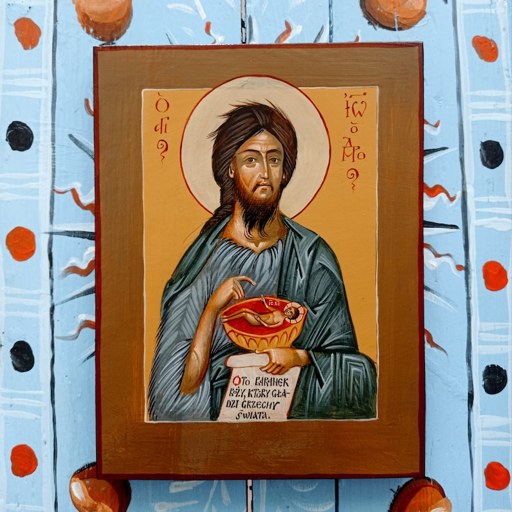
https://www.etsy.com/uk/listing/1518487637/saint-john-the-baptist-picture-icon
License: unknown
John
Saint- Gender
- male
- Church
- Catholic
Biography
The personal name John (from Hebrew Yohanan, meaning Yahweh is gracious, via Greek Ioannes and Latin Ioannes) is among the most frequently attested names in Christian history and hagiography. It is borne by New Testament figures, late antique bishops and monks, Byzantine and Latin medieval saints, numerous Bishops of Rome, Coptic popes of Alexandria, and patriarchs of several Eastern sees. In the absence of a surname, epithet, diocese, century, feast day, or other unique identifier—and with both Wikidata ID and Wikipedia URL given as unknown—no single individual can be isolated from this large set. Standard historical method therefore forbids filling a birth year, death year, places of birth, death, or burial, or any office-specific flags from guesswork.
Among the best-known bearers are John the Baptist, whose ministry in the Judaean wilderness is described in the Gospels; John the Apostle, traditionally associated with the Fourth Gospel and with Patmos; John Chrysostom, the late-fourth- and early-fifth-century preacher and archbishop of Constantinople; John of Damascus, the eighth-century Syrian theologian; and a long series of Roman pontiffs from John I in the sixth century through twentieth-century popes of the same name. Each of these men has a distinct, source-based biography. None of those biographies may be transferred to an unspecified John.
Religious affiliation, order, and marital status likewise cannot be stated. Some men named John were married, including certain early clergy in traditions that permitted married priests; many were monks or celibate clergy; others were laymen. Patronages attached to particular saints named John—for example John the Baptist as patron of many cities and of various trades, or John the Evangelist as patron of writers—belong to those specific cults and cannot be listed here without falsely implying identity.
Canonization and beatification, where they occurred, were acts of particular churches regarding particular persons, often centuries after death and under named popes or synods. Without knowing which John is intended, fields for canonized_by, beatified_by, and feast_day must remain empty, as must any claim that the subject was pope or patriarch. The present record therefore contains no verified chronological or geographical data.
This caution follows the rule to prefer a blank field over an incorrect one and never to substitute an office-taking date for a birth date. Should a more precise designation be supplied, the entry could be rewritten from identifiable sources. Until then, the only defensible statement is that the subject is an unidentified historical or legendary figure known only by the common Christian name John, conventionally masculine, about whom no further fact has been verified from a reliable historical source.