John is a saint of the Catholic Church.
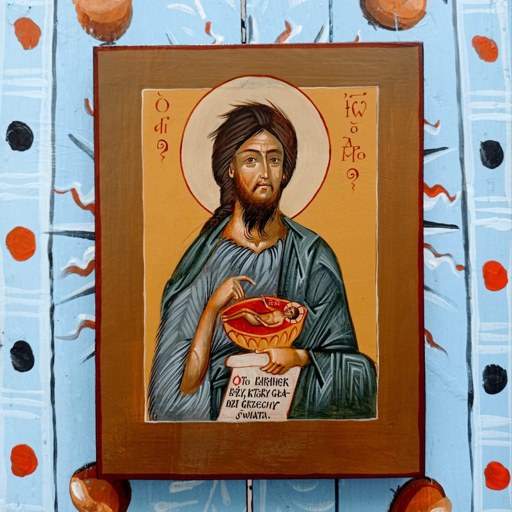
https://www.etsy.com/uk/listing/1518487637/saint-john-the-baptist-picture-icon
License: unknown
John
Saint- Gender
- male
- Church
- Catholic
Biography
The name John is among the most common in Christian hagiography and church history. It has been borne by New Testament figures, desert monks, bishops, patriarchs, popes of Rome, Coptic popes of Alexandria, and a very large number of local saints in the Latin, Greek, Slavic, Syriac, Coptic, and other traditions. The request identifies the subject only as “John,” with no epithet, see, century, Wikidata identifier, or other disambiguating detail. A single verified biography therefore cannot be assigned without guessing, which a careful historian must not do.
The best-known candidates are entirely distinct persons. John the Baptist, the forerunner of Jesus, is associated in the Gospels with the Jordan region in the first century. John the Apostle, often identified in later tradition with the beloved disciple and with the Fourth Gospel, is linked by ecclesiastical writers to Ephesus in Asia Minor. John Chrysostom was a late-fourth- and early-fifth-century preacher who became archbishop of Constantinople. John of Damascus was an eighth-century monk and theologian of Mar Saba. Many other saints named John—of the Ladder, of the Cross, of God, of Capistrano, Bosco, and countless lesser-known figures—have their own dates, places, feast days, and patronages. Several bishops of Rome took the name John, as did patriarchs and catholicoi in the East. None of these lives may be treated as the life of the present subject.
Because no unique historical person can be verified, fields that depend on such an identification are left blank: years of birth and death, places of birth, death, and burial, religious order, spouse, marital and parental status, papal or patriarchal office, feast day, patronages, and the names of those who beatified or canonized the person. Gender is given as male only because John (Hebrew Yohanan, Greek Ioannes, Latin Iohannes) is a masculine given name in the languages of the sources. That is not a substitute for a documented identity.
Hagiographers normally distinguish homonymous saints by epithet, diocese, or century. Until such a qualifier is supplied, the responsible account is this statement of uncertainty rather than a composite or conjectural life.