John Cassian is a saint of the Catholic Church. John Cassian's feast day is celebrated on 23 July.
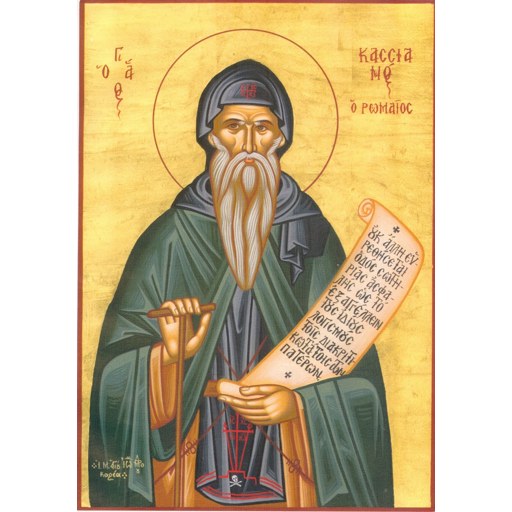
Unknown authorUnknown author
License: Public domain
John Cassian
Saint- Feast Day
- 23 July
- Gender
- male
- Church
- Catholic
Places
Roles & Family
Biography
John Cassian, known also as John the Ascetic and as Cassian of Marseilles, was a monk, writer, and monastic founder active in the late fourth and early fifth centuries. The priest Gennadius of Marseilles, writing toward the end of the fifth century, calls him a Scythian by nation. Historians generally understand this to mean that Cassian was born in the Roman province of Scythia Minor, on the western Black Sea coast in the region later called the Dobruja. A smaller number of scholars have proposed an origin in Gaul. No contemporary source records the year or the town of his birth; estimates placing it around the middle of the fourth century rest only on the later chronology of his travels. Of his family and childhood nothing certain is known. While still a young man he entered, together with a close companion named Germanus, a monastery near Bethlehem in Palestine, and there he received his first formation in the cenobitic life.
Desiring a more complete knowledge of monastic practice, Cassian and Germanus left Palestine for Egypt, then the principal centre of Christian asceticism. They spent a long period, often estimated at roughly a decade, among the monks of the Nile Delta and of the desert of Scetis. They visited well-known elders and observed both hermits and communities living under a common rule. Cassian later recast these encounters as the Conferences, a cycle of spiritual dialogues that became one of the chief vehicles by which the wisdom of the Egyptian desert reached the Latin world. His Institutes likewise draw on Egyptian custom for the habit, the hours of prayer, and the classification of the eight principal vices, a scheme related to the eight evil thoughts taught by Evagrius Ponticus, whose influence on Cassian is widely recognized even though Cassian does not name him.
Near the end of the fourth century the two friends left Egypt. The departure is commonly linked to the Origenist controversy and to the harsh measures taken by Theophilus of Alexandria against the Nitrian monks, though Cassian himself offers no detailed narrative of the crisis. They proceeded to Constantinople, where John Chrysostom, bishop of the city, received them and ordained Cassian to the diaconate. When Chrysostom was deposed and driven into exile, Cassian joined those who sought help from the bishop of Rome. He travelled to Italy carrying letters on Chrysostom’s behalf to Pope Innocent I. After this Roman episode his life is next clearly attested in southern Gaul.
Cassian settled at Massilia (Marseille), a Mediterranean port with long-standing ties to the East. In the early fifth century he founded two monasteries, one for men and one for women. The men’s house, later known as the Abbey of Saint-Victor, stood near the tombs of Marseille’s early martyrs and became an important monastic centre in Gaul. At the request of Castor, bishop of Apt, he composed the Institutes and the Conferences in order to give western communities a reliable account of Egyptian monastic doctrine and practice. A third major work, On the Incarnation of the Lord against Nestorius, was written at the instance of the Roman archdeacon Leo, afterwards Pope Leo I, and belongs to the controversy that led to the Council of Ephesus. Ancient writers sometimes style Cassian a priest; the date and place of any presbyteral ordination are not securely documented.
In the thirteenth Conference Cassian proposed an account of grace intended to avoid both Pelagian self-reliance and what he regarded as an excessively one-sided reading of Augustine. He allowed that the first movement toward God might arise from the human will, while holding that every subsequent advance depends on grace. Later Augustinian critics labelled this teaching semi-Pelagian. Cassian wrote against Pelagius and was never condemned by name, yet the Second Council of Orange in 529 rejected related views current among Gallic monks. Regardless of that dispute, his books became standard reading in the West. The Rule of Saint Benedict recommends the Institutes and the Conferences to the monastic community, and through Benedictine tradition Cassian’s desert inheritance shaped medieval spirituality. The Christian East likewise venerates him as a saint and a faithful witness to the fathers of the desert. He died at Marseille during the joint reign of Theodosius II and Valentinian III, in the second quarter of the fifth century, and was buried at the Abbey of Saint-Victor. Western churches observe his feast on 23 July; the Eastern Orthodox Church commemorates him on 29 February. His cult dates from late antiquity and did not arise from a formal papal canonization.