John III Doukas Vatatzes is a saint of the Catholic Church (d. 1254). John III Doukas Vatatzes's feast day is celebrated on 4 November.
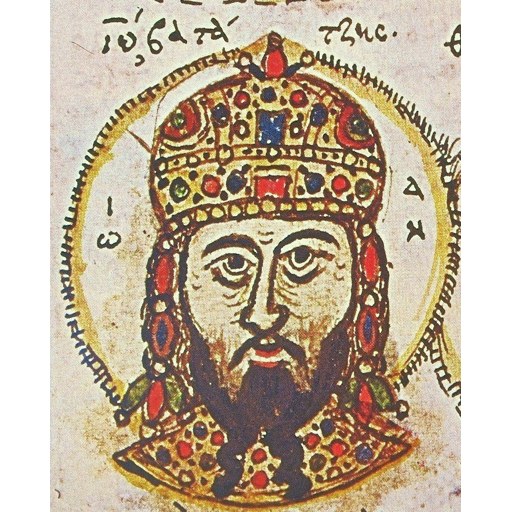
Unknown Byzantine artist
License: Public domain
John III Doukas Vatatzes
Saint- Life Span
- d. 1254
- Feast Day
- 4 November
- Gender
- male
- Church
- Catholic
Places
Roles & Family
Religious Information
Biography
John III Doukas Vatatzes was emperor of the Empire of Nicaea from 1221 until 1254 and is venerated as a saint in the Eastern Orthodox Church. He was born in the late twelfth century at Didymoteicho in Thrace, into the Doukas Vatatzes family, a military aristocratic lineage of the Byzantine world. His father, the general Basil Vatatzes, died on campaign in the 1190s. Through his maternal kin John was connected with the Angelos emperors of the late twelfth century. He rose at the court of Theodore I Laskaris, who after the Fourth Crusade’s capture of Constantinople in 1204 had established at Nicaea a Greek successor state that claimed the unbroken Roman imperial title and sheltered the patriarchate of Constantinople in exile. In the early thirteenth century John married Theodore’s daughter Irene Laskarina. When Theodore I died in 1221, John succeeded him, but brothers of the dead emperor contested the succession and sought help from the Latin Empire. John defeated that coalition at Poimanenon in 1224, secured the throne, and recovered much of northwestern Asia Minor from Latin occupation.
His reign of more than three decades made Nicaea the strongest of the Byzantine successor states and the most plausible instrument for restoring Roman rule in Constantinople. He combined warfare with diplomacy, fighting the Latin Empire, the Greek rulers of Epirus and Thessalonica, and at times the Bulgarian empire, while exploiting the decline of the Seljuk Sultanate of Rum after the Mongol victory at Köse Dağ in 1243. In 1246 he entered Thessalonica and brought large parts of Macedonia and Thrace under Nicaean authority. He also extended control over Aegean islands, including Rhodes. Although Constantinople remained in Latin hands until 1261, his campaigns reduced the Latin Empire to a remnant and left Nicaea dominant in both the Balkans and western Asia Minor. He maintained a professional army, employed Cuman and other mercenary contingents, and kept the traditional Byzantine gold coinage at a high standard of purity and reputation.
Contemporary and later sources praise his administration as well as a personal austerity and charity that later supported his cult. He encouraged agriculture and domestic crafts, including silk production, and tried to limit the economic hold of Italian merchants on his subjects. He founded or endowed charitable houses and was remembered for hearing petitions and relieving the poor, which earned him the epithet “the Merciful.” His first wife, Irene Laskarina, was injured in a riding accident, retired to monastic life, and died in 1239. Their son Theodore was raised as heir and later reigned as Theodore II Laskaris. In 1244 John contracted a second, diplomatic marriage with Constance, an illegitimate daughter of the Holy Roman Emperor Frederick II; she took the name Anna at the Nicaean court. The marriage sealed an alliance with the Hohenstaufen against common Latin and papal adversaries and produced no surviving children. In later life John suffered from epilepsy.
He died on 3 November 1254 at Nymphaion in Lydia, a palace-city he favored in western Asia Minor, and was buried at the monastery of Sosandra near Magnesia, which he had founded. His son Theodore II succeeded him. A cult of sanctity developed around John’s tomb in the Magnesia region not long after his death. The Eastern Orthodox Church commemorates him as Saint John Vatatzes the Merciful, with a feast on 4 November. Orthodox tradition honors him as a just and philanthropic emperor who defended the church, sustained a Greek Orthodox polity in exile, and prepared the recovery of Constantinople under the Palaiologoi.