John Neumann is a saint of the Catholic Church (1811 - 1860). John Neumann's feast day is celebrated on January 5. John Neumann is the patron saint of Catholic education;immigrants;sick children.
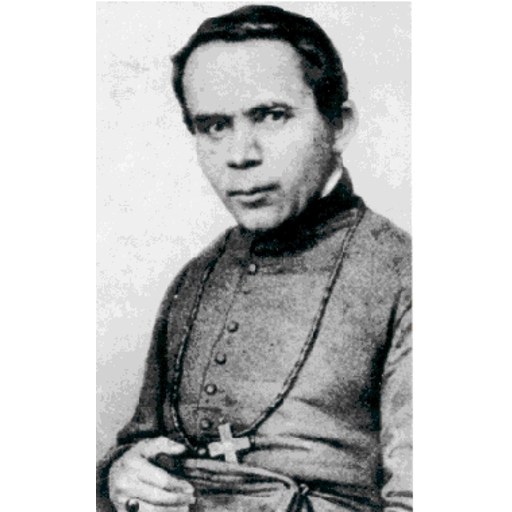
Unknown authorUnknown author
License: Public domain
John Neumann
Saint- Life Span
- 1811 - 1860 (age 49)
- Feast Day
- January 5
- Gender
- male
- Church
- Catholic
Places
Roles & Family
Religious Information
Patronage
Catholic education;immigrants;sick children
Canonization
Biography
John Nepomucene Neumann was born on 28 March 1811 in Prachatice (then commonly called Prachatitz) in the Kingdom of Bohemia, a crown land of the Austrian Empire and now in the Czech Republic. He was the third of six children of Philipp Neumann, a German-speaking stocking knitter originally from Bavaria, and Agnes Lebisch, who was of Czech background. Named for the Bohemian martyr Saint John of Nepomuk, he received a Catholic education locally and at the gymnasium in Budweis (České Budějovice). In 1831 he entered the diocesan seminary there and later continued theology at the university in Prague, where he also studied English and other languages with a view to missionary work. Bohemia then had more priests than available posts. Unable to obtain ordination at home and drawn to serve German-speaking immigrants in North America, he left Europe in 1836 while still a deacon.
He arrived in New York in June 1836 and was ordained a priest on 25 June 1836 by Bishop John Dubois of New York. He was sent to the Niagara frontier in western New York, ministering to scattered German and other immigrant farming communities around Williamsville and North Bush. The assignment meant long journeys on foot, poverty, and celebrating the sacraments in cabins and farmhouses. In 1840 he entered the Congregation of the Most Holy Redeemer (the Redemptorists). He professed vows in Baltimore in January 1842, the first Redemptorist profession in the United States. Over the next decade he served in Redemptorist parishes and missions in Maryland, Pennsylvania, and Ohio, including as pastor of Saint Philomena in Pittsburgh, and as superior of the Redemptorists in the United States. Fluent in German, Czech, English, French, Italian, Spanish, and Irish Gaelic, among other languages, he was a valued preacher and confessor among immigrant congregations. He became a naturalized citizen of the United States in 1848.
In 1852 Pope Pius IX appointed him the fourth Bishop of Philadelphia, and he was consecrated on 28 March 1852, his forty-first birthday. The diocese was large and growing quickly through Irish, German, and other Catholic immigration. As bishop he convoked the first diocesan synod, promoted the Forty Hours Eucharistic Devotion, and made parish schools a central work of his episcopate. He is credited with organizing the first diocesan Catholic school system in the United States and with a marked increase in the number of Catholic schools in his see. He supported the foundation of the Sisters of Saint Francis of Philadelphia and invited other religious institutes to teach and to care for the sick and orphans. Many churches were built under his direction. He remained personally austere and continued to travel widely through the diocese.
Neumann died suddenly of a stroke on 5 January 1860 in Philadelphia, collapsing in the street while on an errand; he was forty-eight. He was buried in the Redemptorist church of Saint Peter the Apostle in Philadelphia, where his remains are venerated at the National Shrine of Saint John Neumann. Pope Paul VI beatified him on 13 October 1963 and canonized him on 19 June 1977. He was the first bishop of the United States to be canonized. The Church keeps his feast on 5 January. He is invoked especially as a patron of Catholic education and of immigrants.