John of Ávila is a saint of the Catholic Church (1499 - 1569). John of Ávila's feast day is celebrated on 10 May. John of Ávila is the patron saint of Andalusia;Spanish secular clergy.
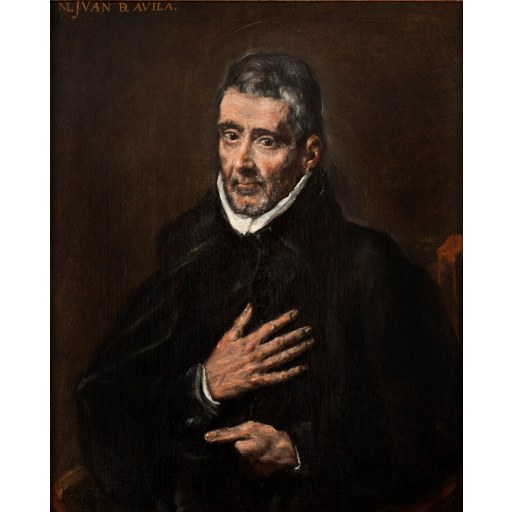
Workshop of El Greco
License: Public domain
John of Ávila
Saint- Life Span
- 1499 - 1569 (age 70)
- Feast Day
- 10 May
- Gender
- male
- Church
- Catholic
Places
Relics & Where to Venerate
Location unknown
The bodily remains of John of Ávila are a first-class relic. Venerated at Basilica of St. John of Avila.
Roles & Family
Patronage
Andalusia;Spanish secular clergy
Canonization
Biography
John of Ávila (Juan de Ávila) was born on 6 January 1499 in Almodóvar del Campo, in New Castile, to Alfonso de Ávila and Catalina Xixón (Gijón), a prosperous family sometimes described in later biographies as of possible converso background. He was sent to study law at the University of Salamanca about 1513, but after several years he abandoned the course without taking a degree and returned home to a life of prayer and austerity. He then studied arts and theology at the University of Alcalá de Henares and was ordained a priest in 1526. After celebrating his first Mass in his native town he sold the family property and distributed the proceeds to the poor, intending to sail as a missionary to New Spain.
The Archbishop of Seville, Alonso Manrique de Lara, detained him in Andalusia to preach there instead. From the late 1520s he conducted an intense itinerant apostolate across Seville, Córdoba, Granada, Baeza and other Andalusian towns, attacking clerical luxury and calling for conversion of life; this work earned him the later title Apostle of Andalusia. His popularity and reforming language led to denunciation before the Inquisition. He was imprisoned in Seville from 1531 to 1533 on charges connected with illuminism, then acquitted. During confinement he began the spiritual treatise Audi, filia (Listen, O Daughter), which became his best-known work.
Remaining a secular priest rather than joining a religious order, he gathered priest-disciples and promoted clerical education, notably through the University of Baeza, founded in 1538. He served as spiritual director or correspondent to leading figures of the Spanish Catholic Reformation, including Teresa of Ávila, John of God, Francis Borgia and Ignatius of Loyola; he declined to enter the Society of Jesus but sent followers to it. His writings—letters of direction, sermons, and treatises on the priesthood and the spiritual life—circulated widely in manuscript and print and later underpinned his reputation as a master of priestly formation.
In later years chronic ill health led him to withdraw to Montilla in the province of Córdoba, where he continued to write and to direct souls until his death on 10 May 1569. He was buried in the Jesuit Church of the Incarnation in that town. A cult developed locally and among the Spanish clergy. Pope Leo XIII beatified him on 12 November 1893; Pope Paul VI canonized him on 31 May 1970. Pope Pius XII had already named him patron of the Spanish secular clergy in 1946. On 7 October 2012 Pope Benedict XVI declared him a Doctor of the Church. His feast is kept on 10 May.